Disclosure : This post may contain affiliate links or paid partnerships. I may earn compensation if you click a link or make a purchase, at no additional cost to you. See my disclosure for more info.
There’s a spot in most backyards that time forgot.
Neglected grass. A forgotten hose bib. An old pot plant nobody’s watered in months.
You walk past it constantly. And every time, there’s a quiet whisper. A plunge pool. A cold dip on an unbearable afternoon. A reason to come home looking forward to stepping outside.
Then practicality shows up uninvited. What does it cost? How long does it take? Is the disruption worth it?
Here’s the thing: a plunge pool isn’t a swimming pool in a smaller box. It’s a fundamentally different proposition — more intimate, more manageable, and far more achievable than the imagination tends to make it.
Choose carefully and it won’t just improve your yard. It’ll change the way you spend your evenings.
Here are nine designs worth your attention, and a few lessons from projects that didn’t go as planned.
First, the Difference Between a Plunge Pool and a Swimming Pool
Worth establishing clearly before we go further.
A plunge pool is compact and runs deeper than a traditional backyard pool. Its purpose is soaking and refreshment, not swimming laps. Think of it as a purpose-built immersive experience rather than a sports facility.
Most plunge pools run between 6 and 15 feet long. That makes them viable for city gardens, courtyards, and tight suburban lots where a conventional pool would be a fantasy.
Smaller volume also means lower running costs, less chemical upkeep, and significantly faster builds.
The part of the story that deserves more airtime.
1. The Natural Stone Plunge Pool
Close your eyes for a moment and think of a remote rock pool. Warm stone underfoot. The sound of water. Plants pressing in from all sides.
That’s what a well-executed natural stone plunge pool can feel like — right in your own backyard.
Materials like flagstone, travertine, and limestone bring warmth, texture, and organic authenticity that no manufactured product can replicate. Irregular edges follow the natural form rather than fighting it.
This design belongs in cottage gardens, in Mediterranean-influenced properties, and in rural settings where a polished concrete rectangle would look like a mistake.
And stone stays kinder to bare feet in direct sun than most alternatives. A small thing. But you’ll appreciate it every summer.
It’s the kind of pool that rewards patience. Not everyone sees it immediately. Then they do, and they never stop noticing.
Add landscaping rocks in warm earthy tones around the surround, vertical garden panels along the fence, and a pair of chaise lounges on the stone deck to complete the picture.
2. The Plunge Pool With a Built-In Sitting Ledge
Here’s a story that plays out more often than it should.
Someone builds their dream plunge pool. It looks perfect. They step in on the first warm day full of anticipation.
And then they stand there. Shifting weight. Half-crouching. With no comfortable place to actually be.
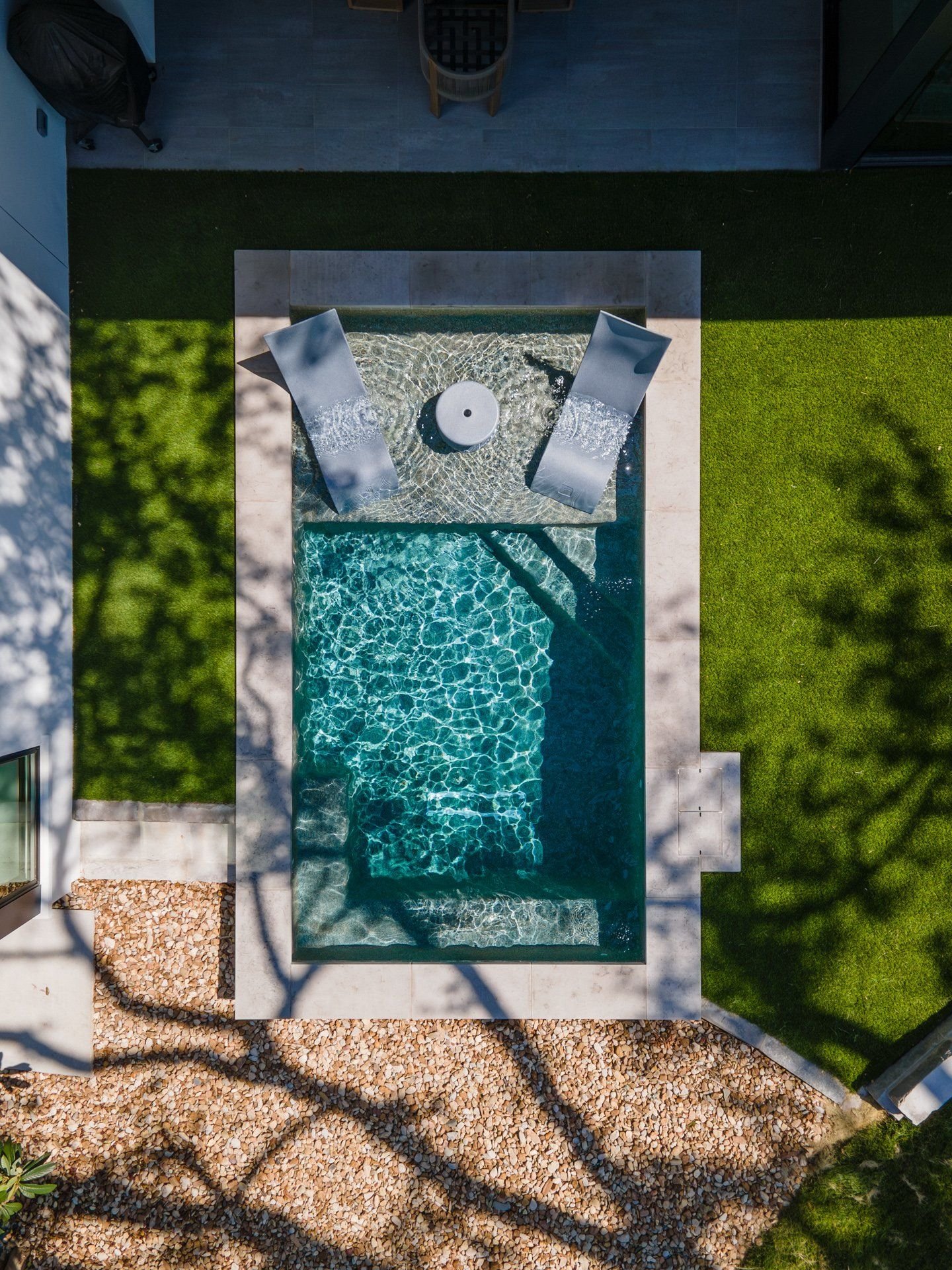
The problem is a missing underwater bench. One ledge along the inside wall is all it takes to transform the experience. You have somewhere to settle. The water comes up to your chest. You relax properly for the first time.
Some homeowners take the L-shaped route, turning one corner of the pool into a social alcove where conversation happens naturally over cold drinks.
It costs less to include than most assume. And it’s the detail that gets mentioned every single time someone uses the pool.
Pair it with an in-pool stool at the pool edge, a striped indoor/outdoor rug to define the outdoor room, and patio side tables nearby for drinks and essentials.
3. The Freeform Plunge Pool With Lush Tropical Plants
Some backyard transformations are gradual. And then there’s this one.
A freeform pool with tropical planting doesn’t ask you to suspend disbelief. It earns it. Walk out the back door and you feel the shift. The noise of the day recedes. The plants press in. The temperature drops. The world outside feels far away.
Palms overhead. Birds of paradise at the edge. Oversized broad-leaved plants pushing forward. A cluster of boulders adding scale and permanence.
Curved pool edges reinforce the effect. Organic lines lie more gently in a garden than right angles, and in doing so, make compact spaces feel more generous.
If your home already leans tropical or coastal, this won’t feel like an addition. It’ll feel like something that was always meant to be there.
Plant tall areca palm trees for height, install a cedar vertical garden panel along the fence line, and hang outdoor globe string lights overhead for evenings that feel impossible to leave.
4. The Raised Concrete Plunge Pool
Sloped yard. Drainage complications. Ground that drops away from the house.
These are the problems that stop most people from ever building a pool. Then someone shows them a raised concrete plunge pool, and the entire conversation changes.
Built partially or fully above grade, this design transforms a problematic site constraint into a visual feature. Clean. Modern. Almost sculptural.
The exterior can be clad in stone, render, or timber to complement whatever surrounds it. And those raised walls? They’re not just structure. They become the best informal seating in the yard. Guests perch. Children dangle legs. You rest a glass on the ledge mid-soak.
Cost note worth keeping: where ground drops away from the house, a raised build can sometimes be cheaper than a conventional in-ground pool because you eliminate the heaviest excavation work entirely.
Add a louvered aluminum pergola alongside for shade and structure, and lay an indoor/outdoor area rug in the seating area to define the zone and introduce warmth.
5. The Plunge Pool Woven Into a Deck
You’ve seen this photograph before. Maybe in a design magazine, maybe on a screen at midnight when sleep wouldn’t come.
The pool sits inside the deck as if it grew there. The water surface is flush with the surrounding timber. You walk toward it and step straight in. No coping. No step down. Just wood, then water.
The deck is the lounge, the dining area, the surround. Everything happens in one continuous plane.
The spatial illusion it creates is significant. Even a modest yard starts to feel like more. Not because anything changed — but because everything now feels intentional.
One hard-learned lesson: the timber directly at the water’s edge needs texture. Smooth composite boards when wet have sent more than a few people to the emergency room. It’s a specification matter that becomes a safety matter if ignored.
Furnish the deck with teak pool chaise lounges and a shade sail stretched above. A concrete-look outdoor side table between the loungers completes the picture without cluttering it.
6. The Cocktail Plunge Pool Fitted With Jets
Most plunge pools have a season. This one has a calendar.
The cocktail pool — also known as a “spool,” blending spa and pool — marries the compact dimensions of a plunge pool with hydrotherapy jets and a temperature control system. Some versions include a dedicated warm end. You choose which experience you want.
Summer: a refreshing cold dip. Winter: a therapeutic heated soak. One structure. Two entirely different experiences. Twelve usable months.
If you live somewhere with real winters and you’re imagining looking at your pool through a fogged-up window from November to March, a cocktail pool eliminates that problem entirely.
At 10 to 12 feet in length, it fits comfortably in nearly any yard without dominating it.
Set up a large cantilever umbrella overhead, keep reclining chaise lounges nearby, and hang outdoor string lights above. The evenings will take care of themselves.
7. The Glass-Paneled Plunge Pool
You’re walking toward the back gate. Someone lets you through. And then you stop.
There’s a pool. But you can see through the side of it. The water glows, and you can watch it from the outside.
That’s the experience a glass-paneled plunge pool delivers. And the description doesn’t quite do it justice until you’re standing in front of one.
One or more engineering-grade acrylic walls replace the solid structure, turning the pool into something between a water feature and a living sculpture. It works best raised or semi-raised, with the clear face oriented toward a seating area or garden path.
At night, with underwater LED lighting inside, the effect shifts from impressive to genuinely unforgettable.
It costs more. It demands careful engineering. Both of those things are simply true.
But if the goal is a backyard that makes every first-time visitor pause and recalibrate — nothing on this list comes close.
8. The Japanese-Inspired Deep Soaking Pool
Some ideas improve by being stripped back rather than built up.
A Japanese soaking pool is exactly that. A rectangle. Dark stone or tile. Maybe a bamboo spout carrying a thin stream of water across the surface. Nothing more.
It’s a form developed over centuries, and its genius is in what it removes. No excess. No noise. Just depth and stillness and water at shoulder height.
Seven feet across. Three or four feet deep. That’s all it takes to have a space that functions as genuine sanctuary.
Surround it with raked pebbles, ornamental grasses, and a simple timber screen. Leave space between elements. Let the negative space do its work.
What you end up with doesn’t feel like a backyard installation. It feels like somewhere you specifically sought out.
One useful note: dark tile absorbs more solar energy. In warmer climates, this reduces mechanical heating requirements and leaves a noticeable mark on your energy bills over a full year.
9. The Courtyard Plunge Pool
The narrow side passage. The walled courtyard with no clear purpose. The slice of space between the house and the fence that’s been accumulating bicycles and forgotten pots for a decade.
These are the spaces most homeowners mentally cross off the list before they ever seriously consider them.
Which is exactly why the courtyard plunge pool surprises people so consistently. A 5-foot-wide, 12-foot-long pool installed in a forgotten corridor transforms it into the most-used space in the entire property.
A vertical garden panel on the fence. warm lights strung above the narrow space. Two loungers placed alongside.
The dead zone becomes the destination. It happens reliably.
This design is particularly well-suited to terraced homes and urban townhouses where a conventional pool footprint isn’t a realistic option.
The best solutions tend to emerge from the tightest constraints. This one is proof.
The Mistakes That Turn Good Projects Into Expensive Lessons
Before you pick up the phone, let’s talk about the things that go wrong. Because they do go wrong. With some regularity.
Mistake 1: Skipping permits.
The rationale is always the same: it’s too small to need one. In most jurisdictions, it doesn’t matter. Any permanent in-ground water structure requires a building permit. Skip this and you risk fines, forced removal, and complications when you eventually want to sell the property.
Call your local building department before anything else happens on site.
Mistake 2: Ignoring drainage.
Bathers displace water. That water doesn’t disappear. Without properly designed overflow management and site grading, it migrates toward your foundations, your neighbor’s fence, or your garden beds. Solve this in the design phase or manage the consequences indefinitely.
Mistake 3: Economizing on filtration.
Smaller pool, smaller water volume. Smaller water volume means faster and more dramatic chemistry changes. An underpowered filtration system produces recurring water quality failures. Invest in a filtration and sanitation setup properly matched to your pool’s volume. This expense pays for itself many times over.
Mistake 4: Not planning for shade.
A plunge pool exposed to unbroken afternoon sun becomes a warm bath by midsummer. That’s not what you built it for. A shade sail, pergola, or large umbrella overhead transforms how the pool functions during peak summer heat. Plan it in from the beginning, not as an afterthought.
How to Choose the Right Design for Your Actual Situation
The choice gets simpler when you answer three questions honestly.
One: How much space do you genuinely have? Measure it. Don’t estimate.
Two: How will you use it most often? Morning cool-down before work? Evening entertaining? Year-round soaking therapy? The honest answer points directly toward the right design.
Three: What does your property already look like? A glass-walled contemporary pool beside a stone farmhouse will never look right, regardless of how well it’s built. Match the visual character of what’s already there.
Answer those three honestly and the decision makes itself.
Your Backyard Has Been Patient. It’s Time to Reward That.
You spend more time at home than almost anywhere. You pay for it. You maintain it. You talk about what you’re eventually going to do with it.
Most people treat the outdoor space like a category they’ll deal with later. Later keeps moving.
A plunge pool ends that indefinite deferral.
It gives you something to come home to outside of the four walls. A space to decompress, to entertain properly, to use the property you’ve worked to own.
You don’t need a large yard. You don’t need an exceptional contractor. You don’t need an extraordinary budget.
You need a plan that fits reality, a design that fits the space, and the decision to move forward rather than tab back to the browser.
The backyard is still waiting. At this point, it’s earned an answer.