Disclosure : This post may contain affiliate links or paid partnerships. I may earn compensation if you click a link or make a purchase, at no additional cost to you. See my disclosure for more info.
Picture it for a moment.
Warm morning light filtering through gauzy curtains. The smell of something earthy and clean — like dried herbs and sun-warmed stone. Soft linen sheets that feel like they’ve been washed a hundred times.
A room that doesn’t just look good. A room that makes you feel something.
That is what a properly executed Mediterranean bedroom delivers. And it’s more achievable than you might think.
This guide gives you 25 Mediterranean bedroom ideas, organized from structure to finishing touch, to help you build that room without guesswork.
Laying the Groundwork: Walls, Floors, and Architecture
Every great room is built on a great foundation. Before you select a single decorative object, the physical bones of the room need to be right.
These are the decisions that everything else depends on.
1. Paint your walls a warm, matte white or ivory
The walls of a Mediterranean home are rarely stark white. They carry warmth — a slight cream, a soft ivory, a faint warmth in the undertone — and they are almost always flat or matte in finish.
For a more immersive result, limewash paint creates the textured, time-worn surface of a coastal home. It’s available in DIY-friendly formulas that can be applied by anyone.
2. Go terracotta on the floor, or simulate it convincingly
Terracotta tile is as Mediterranean as olive oil. It appears in homes across Spain, Italy, Morocco, and Greece for one simple reason: it works. Warm, earthy, naturally beautiful.
If replacing the floor is not practical, peel-and-stick terracotta tiles are an effective and removable solution. A natural jute or sisal rug over the top adds softness and completes the sensory picture.
3. Choose an arched headboard as your architectural statement
Arches are the defining structural shape of Mediterranean architecture. They appear in doorways, cloisters, garden walls, and window frames.
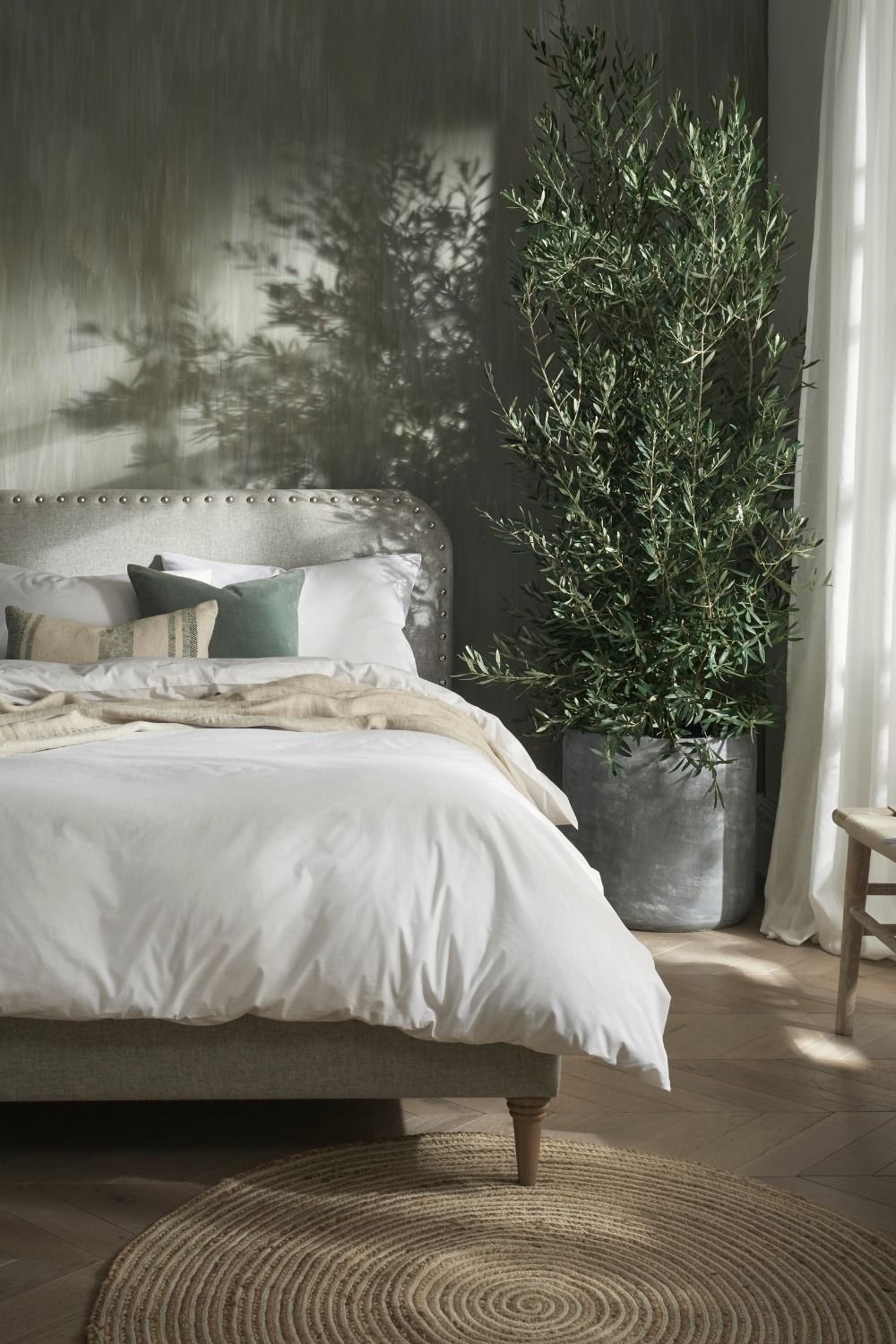
An arched upholstered headboard in natural linen or cotton translates that shape into the bedroom. It becomes the room’s focal point and its strongest single reference to Mediterranean form — without a single tool or permit required.
The Color Palette: Less Blue Than You Think
Before we go further: there is a persistent misconception about Mediterranean color.
People assume it means blue. Often, a lot of blue. Mediterranean blue walls. Blue bedding. Blue accessories.
The reality is more restrained — and more beautiful for it.
4. Let warm neutrals do the heavy lifting
Warm beige, soft clay, sandy ivory — these are the dominant tones in an authentic Mediterranean bedroom. They provide the visual warmth that defines the style at a foundational level.
Blue comes later. Earth comes first.
5. Position blue as a precise accent color
A pair of indigo linen pillowcases. A ceramic blue vase on the nightstand. A hand-painted decorative tile or two.
Two or three blue elements in a warm, neutral room is the formula. Each blue element becomes a moment — something that catches the eye and rewards it.
6. Ground the palette with terracotta and rust
A terracotta plant pot on the windowsill. A rust-colored throw blanket draped loosely at the foot of the bed. A rust-toned pillow in natural cotton.
These are the colors of the region’s soil, its rooftops, and its artisan traditions. They keep the room tethered to the land and prevent it from drifting toward generic beach-house territory.
7. Add green from the landscape
Olive. Sage. Herb-green.
The Mediterranean is not just blue sea and golden stone — it is deeply green. sage green linen curtains at the windows. A potted rosemary plant. Eucalyptus in a tall floor vase. These bring the outside in and give the room biological life.
Textiles: The Layer That Makes It Feel Real
Walls, floors, and palette give a room its look. Textiles give it its feel.
And in a Mediterranean bedroom, the feel is everything.
8. Dress the bed in linen, nothing else
Linen is not a trend. It is a tradition. Mediterranean homes have used it for centuries because it breathes through the summer heat, softens over time, and develops a kind of lived-in beauty that no other material replicates.
Natural, undyed linen — or soft shades of oatmeal, sand, or blush — is the move. Do not substitute cotton percale and expect the same result.
9. Drape a throw across the bed casually
Mediterranean bedrooms are lived in, not styled. The difference shows in how textiles are placed.
A hand-loomed Turkish cotton throw tossed loosely across the foot of the bed — not folded, not arranged — signals that someone actually sleeps here. That casualness is the aesthetic.
10. Hang light, airy curtains that respond to movement
Heavy lined curtains seal out light and air. They are the decorative equivalent of closing a door.
Sheer white linen panels, hung wide and long, do the opposite: they admit light, catch the air, and make the room feel connected to the world beyond its walls. That connection is what the Mediterranean bedroom is built on.
11. Lay a natural-fiber or flat-weave rug underfoot
Jute. Sisal. A flat kilim in muted tones.
Skip anything thick, synthetic, or heavily styled. The floor in a Mediterranean room communicates the same values as the rest of the room: natural, honest, and tactile.
A vintage-style kilim rug in warm, faded colors under the bed brings pattern and warmth without overwhelming the palette.
Furniture: Quality Over Matching
Here is what the furniture of a genuine Mediterranean room is not: coordinated. It is not purchased as a set from a single brand. It is not the same finish repeated across every surface.
It looks gathered. Inherited. Found at different times and in different places.
12. Anchor the room with a solid wood bed frame
The most important piece of furniture in the room earns its authority through material honesty.
Oak. Walnut. Reclaimed pine. Whatever the species, the grain should be visible and the finish warm. A low-profile platform bed frame with clean, simple proportions lets the material carry the weight of the room without visual noise.
13. Flank the bed with rattan or cane
This one swap — trading a standard painted nightstand for a rattan side table — delivers an outsized change in the room’s character.
Rattan is coastal, warm, and natural. A rounded rattan table or a woven stool used as a nightstand gives the bedside area an entirely different identity in under an hour.
14. Place a worn bench at the end of the bed
A weathered timber bench. A vintage stool. A simple slab of reclaimed wood.
This piece tells a story. It looks as though it has lived somewhere before it lived here, and that history gives the room depth and character that no new purchase can provide.
15. Resist the matching-set instinct
This cannot be stated firmly enough.
Mediterranean rooms do not coordinate. They harmonize — through material, tone, and scale rather than matching finishes. Your two nightstands need not be identical. Your dresser need not relate to your bed.
Embrace the variation. It is the style.
Decorative Details: Small Choices, Big Impact
At this stage, the room has its foundation, its palette, its textiles, and its furniture. What remains is the curating — the details that give the room its personality.
Less is considerably more here.
16. Hang one round organic mirror above the dresser or beside the bed
A round mirror in rattan, driftwood, or carved wood adds the kind of warmth and texture that rectangular mirrors simply cannot.
It reflects light. It softens the wall. And it makes the room feel like someone made a choice about what goes here, rather than defaulting to the obvious.
17. Cluster two or three pieces of handmade ceramic
A handmade vase. A small pottery bowl. A rough-textured holder for a candle.
The imperfections in these objects are the point. Mediterranean craft is characterized by irregularity, texture, and the evidence of human hands. Mass-produced objects cannot replicate this.
18. Arrange a minimal collection of wall art
Two or three pieces, thoughtfully spaced. A pressed botanical. An old coastal print. A simple abstract in earthy tones.
Simple frames. Generous spacing. The wall around the art is as important as the art itself.
19. Place botanicals throughout the room
Dried lavender. A rosemary plant. An olive branch. Eucalyptus in a ceramic vase.
These are not accessories. They are an argument: that a bedroom should smell and feel like it is connected to the natural world. Mediterranean living makes this case everywhere.
20. Add wrought iron or aged brass in small doses
A wrought iron curtain rod. Brass drawer pulls on the nightstand. An antique brass table lamp casting warm light from the bedside table.
These metals read as old-world, handmade, and warm. One or two pieces is exactly the right dose.
Lighting: Creating a Room You Want to Be In
Lighting may be the most underestimated design tool in any room.
In a Mediterranean bedroom, the goal is not illumination. The goal is atmosphere.
21. Eliminate overhead lighting from your evening routine
The ceiling fixture serves a functional purpose. It does not serve the room’s mood.
Replace it — at least in the evening — with two bedside lamps and a wall sconce. Select lamps with ceramic, linen, or woven elements. The quality of light they produce, warm and directional, is categorically different from what overhead lighting achieves.
22. Use candles as atmospheric tools
A pillar candle on a simple terracotta plate. A beeswax taper in a brass holder.
No artificial light source creates what candlelight creates. The warmth, the flicker, the sense that the room is doing something rather than just being illuminated — this is atmosphere, and candles are its primary instrument.
23. Treat natural daylight as a design asset
Open the curtains fully each morning. Sheer panels maintain privacy without blocking the light that defines the room’s warm palette and energizes the textures.
Natural light is not a backdrop to Mediterranean design. It is a component of it.
Completion: The Details That Seal It
These last two ideas are small in scale and large in effect. They are also the ones most commonly overlooked.
24. Build a deliberate scent environment
A diffuser with rosemary and bergamot. A lavender linen spray on the pillow. A bowl of dried citrus and herbs on the dresser.
Scent is the sense most directly connected to memory and emotion. The right scent can transform how a room feels more powerfully than any visual element. The Mediterranean smells like something specific — recreate it.
25. Practice discipline on the nightstand
Lamp. Book. One small beautiful object. Water glass.
That is the list.
A nightstand is one of the most personal surfaces in any room. It also tends to become a catch-all. Editing it back to essentials is a practice, not a one-time act — and maintaining that edit is part of what keeps the room feeling like a retreat rather than an extension of the daily chaos.
Begin With Three, and the Room Will Find Itself
Twenty-five ideas. That might feel like a lot to hold.
It isn’t, once you stop thinking of it as a checklist and start thinking of it as a menu. You don’t have to order everything. You just have to order something.
Pick three ideas that speak to you most directly. Commit to them. Execute them well.
The linen bedding and the warm lamps alone will change the room substantially. Add an arched headboard and it will feel like a different space entirely. Keep going from there.
The room you are building is not a destination. It is a direction — and the first step is the only one that takes any decision at all.
🔍 Focus Keyphrase: Mediterranean bedroom ideas
📌 SEO Title (< 60 chars): 25 Mediterranean Bedroom Ideas for a Coastal Escape
🔗 Slug (< 60 chars): mediterranean-bedroom-ideas
📝 Meta Description (< 155 chars): Discover 25 stunning Mediterranean bedroom ideas to create a warm, coastal retreat. Start transforming your space today with these actionable tips.