Disclosure : This post may contain affiliate links or paid partnerships. I may earn compensation if you click a link or make a purchase, at no additional cost to you. See my disclosure for more info.
Something is off about your bedroom and you can’t quite put your finger on it.
The bed is comfortable. The decor is decent. You’ve put real thought into this room.
But it still doesn’t feel like a place you want to sink into at the end of a hard day.
Here’s what’s almost certainly happening: your lighting is working against you. Not subtly — fundamentally.
This is the article that fixes that. Over 12 concrete, tested solutions to the most common bedroom lighting problems — all without calling a contractor, ripping out walls, or spending a significant amount of money.
Let’s diagnose and solve.
The Real Reason Your Bedroom Never Quite Feels Right
You’ve walked into hotel rooms that felt immediately restful. Restaurants where the air just made you breathe deeper.
Lighting is the variable you didn’t notice but absolutely felt.
Your brain processes light as a signal. Bright cool light says: stay alert, keep going. Warm low diffused light says: slow down, relax, the day is ending.
A bedroom dominated by a single overhead fixture pumping out cool white light sends the wrong signal every single evening. Your nervous system never gets clear permission to wind down.
Ambient lighting — warm, layered, and soft — sends the right one. And once you make the shift, you’ll wonder why it took so long.
1. The Problem With Relying on One Ceiling Light
One source. One angle. One temperature. No flexibility. That’s the problem statement for most bedrooms in plain language.
A single ceiling light illuminates the room but creates hard shadows, eliminates depth, and produces the kind of flat uniform brightness that prevents a space from feeling warm.
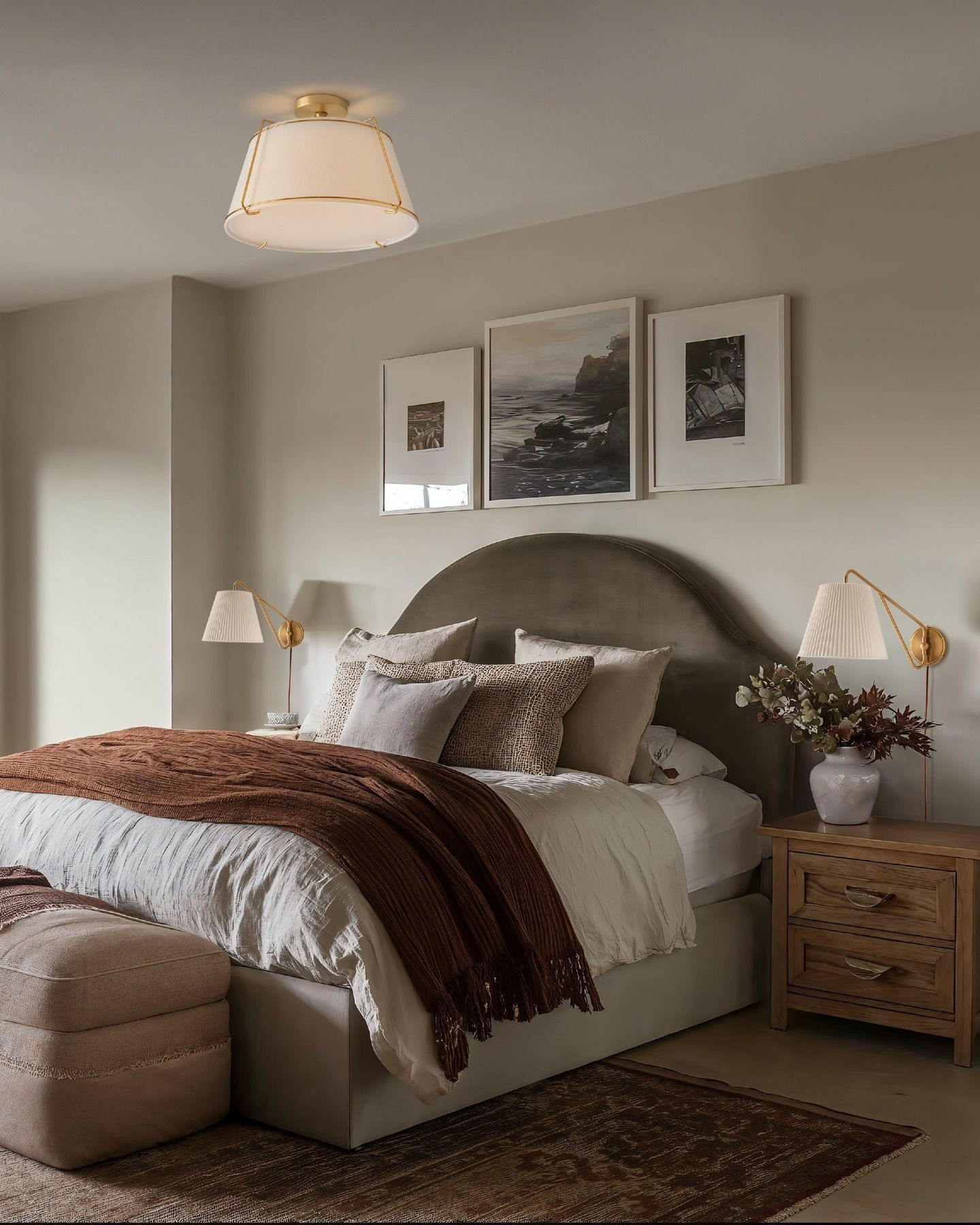
The fix is to layer. Add a bedside lamp for intimate warmth near the sleeping area. Mount a wall sconce for mid-level ambiance. Position a floor lamp in an underlit corner.
Multiple sources at different heights create the atmospheric depth that transforms a functional room into an inviting one.
2. Why the Wrong Bulb Temperature Ruins Everything
You could have every light source correctly placed and still get this wrong. If your bulbs are the wrong color temperature, everything else is undermined.
Color temperature is measured in Kelvins. The warm end (2700K–3000K) produces amber golden light associated with candlelight. The cool end (4000K and above) produces the sharp blue-white of daylight and fluorescent office lighting.
For a bedroom, you want 2700K–3000K. Full stop. Anything outside that range is the wrong tool for this environment.
Look at the Kelvin number on the box before buying. It’s often the only change needed to salvage an otherwise failed lighting setup.
3. The Fix That Takes Five Minutes and Changes Everything
A dimmer switch. That’s it. That’s the fix.
The inability to modulate light intensity is one of the most persistent problems in residential bedrooms. Full bright or full dark. No middle ground.
A dimmer changes that equation entirely. Morning light at full capacity for getting ready. Evening light at 20–30% for winding down. Late-night light at the lowest setting for reading without fully waking yourself.
Hardwired dimmer switches are a quick DIY electrical job. Plug-in dimmer adapters require no installation at all. Both solutions cost less than a dinner out.
4. How a Simple Strip of LED Lights Transforms a Wall
The problem: your headboard wall looks flat and uninspired. The fix: run warm-toned LED lights along the hidden back edge of the headboard.
The light bounces off the wall behind it and creates a soft warm halo. You never see the strip itself — just the glow it produces.
That glow turns an ordinary headboard wall into the visual anchor of the entire room. Self-adhesive kit. Plug-in power. Peel, stick, done.
This is one of the cheapest and most dramatic single improvements you can make to a bedroom.
5. A Salt Lamp Is a Small Purchase With a Big Payoff
The problem: your nightstand area looks flat and generic. The light there feels too bright or too cold.
The fix: swap in a Himalayan salt lamp on your nightstand.
Its naturally orange-amber glow sits at an ultra-low color temperature that makes it almost impossible to be harsh. It’s the ideal low-level source for the bedside — providing just enough light to navigate by while contributing real warmth to the room’s atmosphere.
Functional and decorative in equal measure.
6. Your Lampshades Might Be Working Against You
The problem: your lamps are warm-toned but the light still feels harsh or too direct. The culprit is often the shade itself.
White and light shades pass light through with minimal interference, producing a directed beam that reads as more intense than it should.
The fix: swap to linen, burlap, or a natural woven fabric. These materials scatter and soften light as it passes through, distributing it more evenly.
A shade swap changes the entire character of a lamp’s light output. Do not overlook it.
7. The Right Way to Add Recessed Lights to a Bedroom
The problem with recessed lighting isn’t the concept — it’s the common execution.
Too many cans, full brightness, aimed straight down: this approach strips the room of warmth and replaces it with uniform brightness that feels nothing like a place to rest.
The right approach: two or three cans at most, on a dimmer, angled to wash light across a wall rather than flood the floor. This creates dimensional light with depth and shadow that actually improves a room.
If you’re not renovating, retrofit LED recessed kits drop into existing ceiling cutouts with minimal work.
8. The Shelf Trick Nobody Talks About
The problem: your open shelves look like storage. Functional but forgettable.
The fix: battery-operated puck lights, placed inside each shelf and angled upward.
Light bounces off the rear panel and illuminates the shelf from within. Objects become displayed rather than stored. The whole wall takes on a gallery quality that looks intentional and sophisticated.
No wiring. No holes in the wall. No electrician. Press and place — that’s the entire installation.
9. String Lights Done Right vs. Done Wrong
The problem: you’ve tried String lights before and they looked cheap or juvenile rather than warm and magical.
The fix: structure and intention. Don’t drape them randomly across a surface. Run them along a ceiling perimeter behind a ledge or crown molding for a clean architectural line of light. Or layer them inside sheer curtains so the individual points dissolve into a luminous wash.
Always warm white. Always minimal-gauge wire. The difference between looking magical and looking like a dorm room is entirely in the execution.
10. Upgrade Your Reading Light With a Wall-Mounted Option
The problem: your bedside table lamp takes up too much space, floods the whole room when you just want to read, and doesn’t angle toward the page well.
The fix: a wall-mounted sconce with an adjustable arm. Mounted directly beside the bed, it aims exactly where needed and frees the nightstand entirely.
It doubles as a soft ambient source when the arm is folded back. One fixture, two jobs, cleaner look. Plug-in options mean no electrician required.
11. That Awkward Corner Is Actually an Opportunity
The problem: a dead corner in your bedroom. Too small for furniture. Too prominent to ignore. Just sitting there making the room feel incomplete.
The fix: a floor lamp with a fabric shade. It fills the void with purpose, adds upward-casting warmth, and makes the corner feel occupied and intentional.
Upgrade: an arched floor lamp arching over a reading chair creates a fully realized reading nook — a room within the room.
12. Stop Ignoring Candles — or Start Using Them Properly
The problem: candles in the room, but they’re not doing anything. One candle on a shelf, barely visible.
The fix: treat candles as a composed lighting element rather than a random addition. Group them in odd numbers at varying heights on a tray. Position the grouping somewhere prominent.
If open flames are a concern, flameless LED candles achieve the same visual effect with zero risk.
The arrangement becomes a low warm light source and a design focal point simultaneously.
13. The Free Lighting Upgrade Hiding Behind Your Mirror
The problem: the room feels dim on the far side from your light sources.
The fix: a mirror placed directly opposite the light. A large leaning mirror reflecting a warm lamp doubles its apparent output in that zone of the room.
A round mirror above a dresser and a mirrored tray on a surface each contribute smaller but meaningful improvements.
These are light tools that look like decor.
14. Stop Wasting the Natural Light Already Entering Your Room
The problem: you have blackout curtains that do their job at night but make the room feel cave-like during the day.
The fix: add a layer of sheer curtains in front of them. During the day, the sheers filter incoming sunlight into the most beautiful natural ambient glow you can put in a bedroom.
Keep both. At night draw the blackouts for darkness. During the day let the sheers do their work.
The bedroom works the way it should at every hour.
Why Most Bedroom Makeovers Fail Before They Start
There’s one more problem worth addressing before you go. It’s not a lighting problem. It’s a sequencing problem.
Trying to fix everything at once is the most reliable way to end up with a bedroom that feels cluttered rather than calm. Five new light sources introduced in one afternoon produce visual noise, not warmth.
Solve one problem. Evaluate. Then solve the next. Each fix compounds on the previous one. Approached in sequence, the improvements accumulate into something genuinely transformative.
Patience is the tool that ties every other fix together.
You’re Closer to the Fix Than You Think
The bedroom that doesn’t quite work isn’t broken beyond repair. It just needs a few targeted changes applied with intention.
Every solution in this article is achievable without professional help, without a large budget, and without tearing anything apart.
Pick the fix that addresses your most obvious problem. Start with that one tonight.
Come back and look at what else needs attention. One change at a time, the room you’ve wanted gets closer.
It might already be one dimmer switch away.