Disclosure : This post may contain affiliate links or paid partnerships. I may earn compensation if you click a link or make a purchase, at no additional cost to you. See my disclosure for more info.
You arrive home drained to the core.
Your neck is stiff. Your head is still full of everything left unfinished. Your notifications have not slowed down.
You walk into your bathroom and it offers you… absolutely nothing.
No sense of ease. No comfort. Just a room you barely register anymore, with products piled up and a mirror that needs cleaning.
Familiar?
Here is the truth. Your bathroom could be doing something meaningful for you every single day. It could be the space where everything actually stops — where your body stops bracing and your mind stops running.
That is not an exaggeration. That is what Japanese bathroom design is built around.
Not aesthetics for their own sake. Not design for Instagram. Design that serves the person inside the room.
And getting there does not require tearing anything down, booking a flight, or spending beyond your means.
What it requires is intention. And the right ideas.
Here are twenty-eight of them.
Understanding the Japanese Bathing Philosophy
Before the ideas, the mindset.
In Japan, the bathroom is not treated as a utilitarian space. It is a restorative practice built into the architecture of daily life.
Bathing cleanses not just the surface but the mind underneath it. That belief governs every design decision — the materials used, the spatial flow, the quality of light.
The outcome is a room that functions like medicine.
And the good news? Every single principle here is adaptable to real-world homes and real-world budgets.
Let’s go through them.
Designing the Space Itself
1. Create a physical barrier between wet and dry zones
Traditional Japanese homes have always separated the bathing area from the changing area. The underlying logic: water stays where it belongs.
A glass partition or a subtle floor-level change can establish this division even in modest spaces. The room immediately feels tidier and more composed.
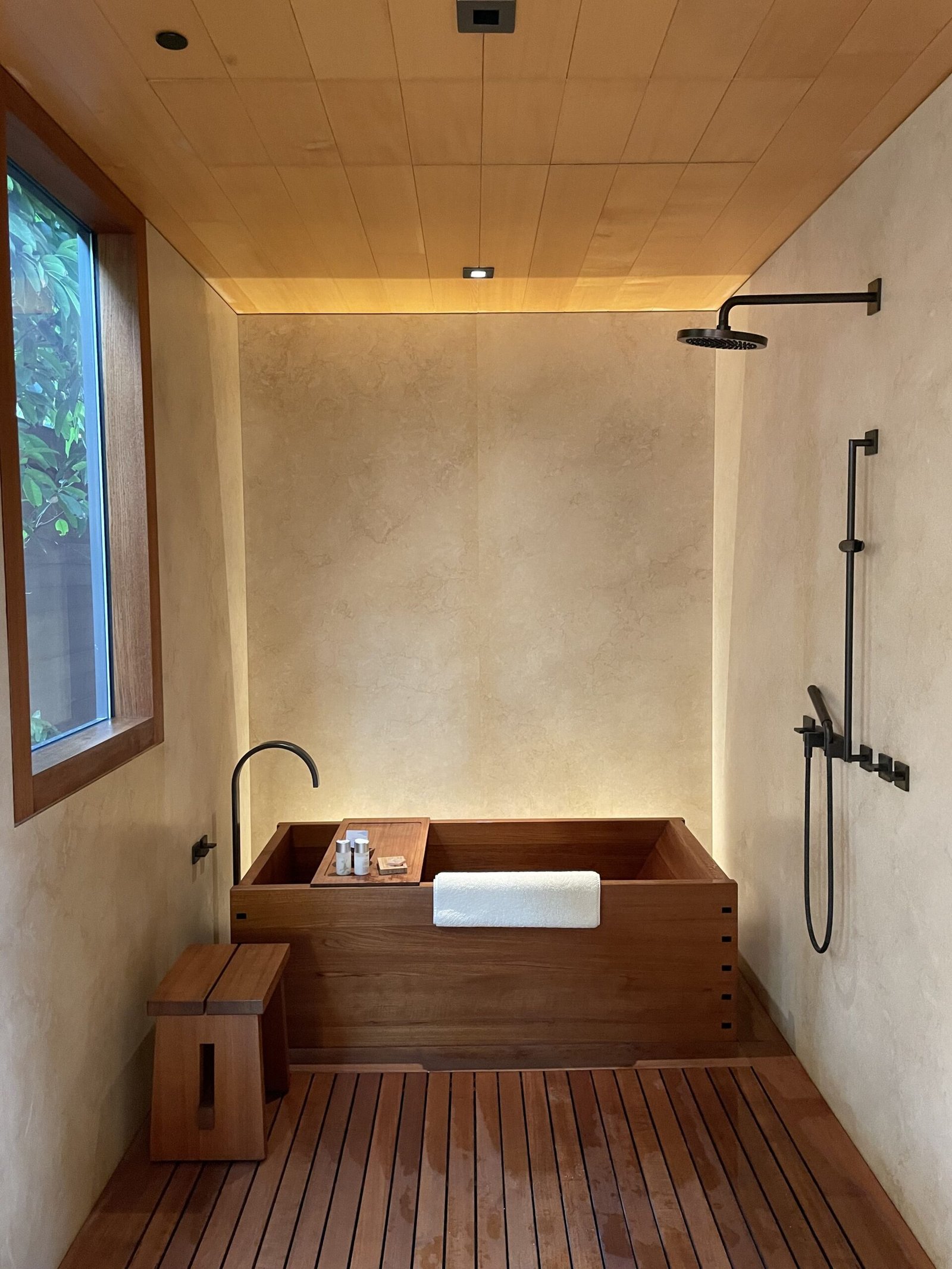
2. Give the soaking tub pride of place
In Japan, the tub is not tucked into a corner or hidden behind a curtain. It occupies the center of the room’s attention.
Everything else in the design supports it, serves it, frames it.
When positioning your soaking tub, consider what you see first when you open the door. That should be it.
3. Create a standing shower station separate from the tub
In the Japanese approach, you wash yourself thoroughly before entering the tub.
A low shower station with a handheld showerhead and a wooden stool for seated washing makes this possible in any bathroom.
Clean water for the soak. The ritual preserved.
4. Separate the toilet from the bathing zone
A door, a partition, a sliding screen. The mechanism matters less than the principle.
When the toilet is removed from view, the bathing area transforms. It feels quieter, more intentional, more private.
Materials That Do the Work For You
5. Work hinoki cypress into your design wherever possible
Hinoki is the wood that defines Japanese bathing culture. Moisture-resistant and mildew-repellent by nature, it is built for wet environments.
But its real gift is olfactory. Steam pulls out a warm, citrusy, forested scent that no candle or diffuser can authentically recreate.
A hinoki bath mat, a wooden stool, or a tray near the tub activates this every time you bathe.
6. Choose stone surfaces for grounding sensory depth
Pebble tiles, polished slate, or smooth river stones underfoot create a primal connection to earth that synthetic materials cannot mimic.
And walking barefoot on a pebbled shower floor doubles as a gentle pressure-point massage — a benefit you didn’t know you were missing.
7. Commit to matte finishes everywhere
Glossy surfaces belong in retail showrooms, not personal sanctuaries.
Matte finishes on every surface — tiles, hardware, and countertops alike — absorb light rather than bouncing it. The cumulative effect is a space that feels warmer, softer, and more human.
8. Introduce texture through washi-inspired wall panels
Washi paper itself cannot survive a wet room. But wall panels that reference its soft, handcrafted texture introduce warmth and visual interest without overwhelming the space.
Restraint is the whole vocabulary here.
The Role of Water in the Design
9. Prioritize the ofuro deep soaking tub above all else
This is the one element without which the Japanese bathroom experience cannot truly exist.
The ofuro is designed for upright immersion — shoulders submerged, water enveloping the entire body. It is shorter and deeper than a Western tub by design.
This is the single upgrade that most profoundly changes how bathing feels. A deep soaking tub is where this philosophy lives.
10. Fit an overhead rain showerhead in the shower zone
A rain showerhead installed directly above covers the body with water falling straight down.
No angled pressure. No adjustments. Just total, even coverage.
This small change elevates rinsing off from a chore to a moment of genuine stillness.
11. Add a sliding-rail handheld shower wand
A sliding rail allows the showerhead to be set at any height — ideal whether standing or seated on a bathing stool.
Functionally simple. Philosophically important — it supports intentional, attentive bathing.
12. Bring a water feature inside for acoustic calm
The sound of trickling water is as culturally embedded in Japan as the act of bathing itself.
A small indoor fountain near the tub, or a wall-mounted spout that trickles quietly, adds a sensory layer that visual design alone cannot provide.
Lighting That Supports Relaxation
13. Replace overhead lights with warm, dimmable alternatives
Standard overhead lighting is the enemy of any calming environment.
Warm LED strips concealed behind mirrors or beneath floating vanities shift the mood completely. A dimmer switch completes the transition.
14. Fit a backlit mirror for soft, even illumination
A backlit mirror eliminates the unflattering contrast of direct vanity lighting.
In its place, a diffused glow that makes the room feel softer, more spacious, and deliberately calm.
15. Layer in candlelight or paper lantern warmth
Japanese lantern-style pendants overhead, or a few candle holders on the edge of the tub, introduce the flicker that tells your body it is safe to rest.
Wellness professionals have understood this for decades. Your bathroom should know it too.
Minimalism as a Daily Practice
16. Store everything; display nothing by accident
Every visible product is a micro-distraction. Enough of them and the room stops feeling restful.
Floating vanities with quiet-close drawers, built-in shower recesses, and hidden cabinetry absorb everything.
The Japanese bathroom is uncluttered because it disciplines itself to be.
17. Work with a strictly limited color palette
Warm white, soft grey, pale stone, natural wood grain.
Choose two of these, maybe three. Then stop. Absolutely no accent walls, no statement tiles, no printed textiles.
A narrow palette is the mechanism by which visual calm and the sensation of space are created.
18. Give one singular object the spotlight
One stoneware vase. One considered soap dish. One stem in a bud vase.
This is the concept of “ma” in practice — the Japanese principle that empty space is itself an element of design, as meaningful as anything placed within it.
19. Unify your towels by color and weight
A single towel out of place in the wrong color can unravel the visual harmony of an entire bathroom.
One shade, one quality, arranged neatly on an open wooden shelf. A small discipline with an immediate and visible impact.
The Natural World as a Design Partner
20. Introduce a plant that genuinely belongs in this environment
Ferns, pothos, peace lily, or bamboo — plants that not only survive but actively benefit from bathroom humidity.
One green presence near the tub draws the room into relationship with the living world. The Japanese call this “shizen” — nature present without effort.
21. Bridge the gap with a bamboo bathtub tray
A bamboo tray across the tub carries tea, a book, a candle — whatever signals to your body that this moment is for you.
Objects are not the point. The ritual structure they enable is.
22. Design a visual resting point in the room
A window deserves frosted glass, not heavy curtains. Let natural light be a design element in itself.
No window? A framed nature print — a forest floor, a shoreline, a misty hillside — gives your eyes somewhere to settle while your body does the same.
Finishing Touches for All the Senses
23. Add a heated towel rack to the wall
Warm fabric after a deep, hot soak is a simple pleasure that feels genuinely luxurious every time.
A wall-mounted heated towel rack is inexpensive, installs quickly, and upgrades every single bath you take for the life of the product.
24. Use natural botanical bundles in the shower
Tie fresh eucalyptus to the showerhead. Steam does the rest. The bathroom fills with a natural, clearing fragrance.
No device required. No artificial ingredients. Nature, activated by heat.
25. Do something about the cold floor
Stepping onto cold tiles first thing in the morning is a small but daily disruption that sets the wrong tone.
Radiant underfloor heating is the ideal. A quality wooden bath mat placed with care is an immediate, affordable solution.
26. Curate what you hear as carefully as what you see
A waterproof Bluetooth speaker playing soft rain, traditional flute, or steady white noise changes the entire character of the space.
You would never leave ugly objects in plain view. Why leave the acoustic environment to chance? Sound is as powerful a design tool as any tile or fixture.
27. Establish a signature fragrance for the space
Not a spray. Not something synthetic.
A hinoki wood chip. One stick of incense lit before you enter. A single drop of cedarwood oil in a ceramic bowl.
“Kodo” — the Japanese practice of fragrance as ceremony — treats scent not as decoration but as a gateway to quieting the mind.
28. Keep a robe or yukata hanging on the door
The transition from warm water to the rest of the world can be gentle or jarring. A robe makes it the former.
A lightweight cotton or linen robe on a simple hook on the door carries the warmth of the soak through to the next moment.
The ritual continues. The spell holds.
Why Building This Room Matters More Than You Think
This is not interior design for the sake of it.
This is building a room that functions as active recovery. A place that works for you while you let go of the day.
Japan encoded this wisdom into its architecture centuries ago. The bath is where you return to yourself. Not a task. Not a hygiene obligation. A daily reset.
You deserve that. And you deserve a bathroom designed to deliver it.
You do not have to act on all twenty-eight of these ideas at once. Choose one. Make it good.
Then let each choice be intentional.
Because the design philosophy we’re talking about was never really about materials or fixtures or lighting temperatures.
It was always about declaring that your moments of rest are worth taking seriously.
Now go take them seriously.