Disclosure : This post may contain affiliate links or paid partnerships. I may earn compensation if you click a link or make a purchase, at no additional cost to you. See my disclosure for more info.
Something in your living room has been quietly bothering you.
It’s functional. It’s tidy. But every time you sink into the couch, there’s this low hum of dissatisfaction. Like the room is performing a version of home without actually being one.
You found industrial design somewhere along the way. Exposed beams, raw metal, concrete floors, factory-style light fixtures that feel like they were salvaged from somewhere with a history.
It pulls at you. The visual language feels right. Honest. Substantial.
And yet every room you study feels inhabited by no one — architecturally dramatic but humanly empty.
“Why does the style I love look so unwelcoming in practice?”
Because most industrial room guides forget the most important layer: the warmth that makes raw materials livable. The strongest industrial interiors treat softness as a structural element, not an afterthought. They build comfort in alongside the concrete.
You can have the honesty of industrial design and a room that genuinely welcomes you. These 39 ideas show you exactly how to do both.
Lighting That Works in Layers, Not Solo
The trap is predictable: one massive industrial pendant hung over the center of the room.
Bold. Photogenic. Completely insufficient.
Atmosphere isn’t a single light source. It’s a composition of multiple sources, each contributing something different. Depth comes from layers.
1. Suspend a cluster of pendant lights at varied heights rather than a single pendant.
Five pendants at different drop distances creates an overhead rhythm. It’s dynamic, dimensional, and instantly more interesting than one center-hung fixture.
2. Place a posable arc or task floor lamp in matte black near a seating area.
Adjustable floor lamps are both practically useful and visually structural. They earn their place twice over.
3. Flank the sofa with warm brass or aged gold wall sconces.
Brass in an industrial room is a reveal. It takes the cold edge off darker metals and adds a refined, slightly vintage quality that feels surprising and intentional.
4. Hang filament bulbs at ceiling level on a black cable run.
This is not fairy lights. This is amber-glowing filament bulbs suspended on a heavy-gauge cable, spaced with intention. The effect is raw, warm, and quietly stunning.
5. Set grouped pillar candles on a metal tray as living light.
Flame is the one lighting source that can’t be replicated electrically. A cluster of candles on a flat metal tray beside the sofa contributes something no overhead fixture ever could. Movement. Heat. Life.
Greenery and Natural Objects — Biological Warmth
The most immediate correction for an industrial room that reads as sterile?
Put biological life into it.
Plants, dried botanicals, stone, natural fiber — these materials interrupt the dominance of hard surfaces and introduce warmth that no manufactured object can replicate.
6. Place a large plant in a bare corner to add vertical life.
A tall fiddle leaf, rubber tree, or sansevieria in a handwoven basket solves the empty corner and adds organic warmth simultaneously.
7. Group small potted species on a metal bracket shelf.
A rotating collection of three to five small plants in varied pots creates a living installation that shifts with the seasons.
8. Fill a stoneware vase with dried stems, branches, or preserved flowers.
Low-maintenance and high-texture. Dried botanicals read as intentional styling rather than neglect when chosen carefully and displayed well.
9. Use natural stone objects — a marble catchall tray, a geode bookend — as grounding accents.
Stone has weight and temperature and visual calm. It adds a natural layer to the material palette without asking for attention.
Starting With the Right Structural Bones
Every good room starts with structural clarity. Before any piece of furniture or accessory lands, the architecture needs to be working in your favor. These choices shape the character of everything that follows.
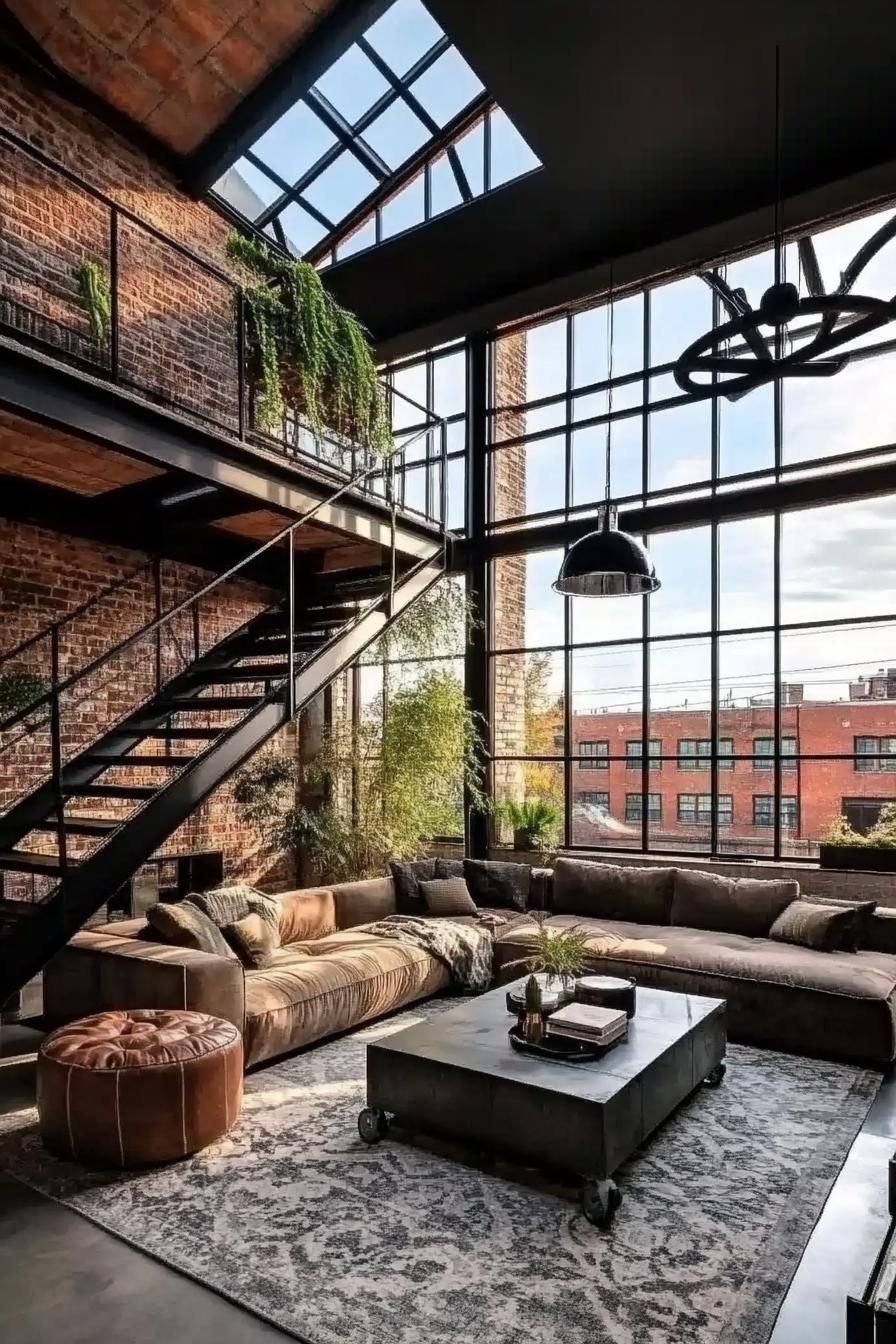
10. Uncover one wall’s brick and leave surrounding walls quiet.
One brick wall communicates industrial powerfully. Surrounding walls in warm white prevent the room from feeling claustrophobic or heavy.
11. Seal and polish concrete floors before calling them finished.
The difference between raw and sealed concrete is the difference between neglect and intention. A sealed surface has warmth and presence that raw concrete simply lacks.
12. Choose reclaimed wide-plank timber flooring as an alternative to concrete.
Salvaged wood brings visual warmth, physical texture, and a sense of accumulated history. It is in every way the warmer flooring option for an industrial room.
13. Fit the windows with oversized black steel-frame glazing.
Steel frames are the architectural hallmark of industrial interiors. Oversized steel-framed windows flood the room with light while giving the bones a decisive industrial statement.
14. Let structural ceiling beams show — and stain them in warm tones.
Exposed beams announce industrial character the moment someone looks up. Warming them with a honey or amber stain ensures that announcement feels welcoming rather than clinical.
15. Claim exposed ductwork as a design element with matte black paint.
Visible mechanical systems can be either an eyesore or an asset. Flat black paint makes all the difference — transforming functional infrastructure into graphic line work overhead.
Furniture Selections That Pair Industrial With Inviting
Industrial furniture choices cause most of the problems.
Steel frames, reclaimed planks, rivet detailing — selected en masse, they produce a room with nowhere to rest. Nothing soft to land on. Nowhere that feels like home.
The solution: match every hard surface with something that yields.
16. Start with a substantial leather sofa in a warm, lived-in tone.
Full-grain leather in cognac or brown ages into the space rather than fighting it. An oversized, well-cushioned sofa is the warmest single furniture choice you can make for an industrial room.
17. Center the arrangement around a live-edge wood coffee table.
Organic, natural-edged timber introduces movement and life into all that structural geometry. The more character the slab carries, the better it works.
18. Add upholstered accent chairs opposite the sofa.
The fabric — velvet, boucle, linen — does the work of softening the room. These chairs are invitations. Seats that say “this room is for staying in.”
19. Leave an iron-and-wood bookshelf partially empty.
Strategic gaps. A book, a plant, a single ceramic piece per section. Edited and open reads as confident; packed and full reads as anxious.
20. Repurpose a leather trunk with patina as an occasional table.
A piece with real history gives the room the sense that it evolved over time. Storage is a bonus. The character is the point.
21. Bring a chunky woven floor pouf into the seating area.
Poufs disarm the severity of industrial interiors by being simultaneously casual and tactile. They belong, and they make the room feel less like a photo shoot and more like a gathering place.
Color Choices That Build in Warmth From the Ground Up
The biggest color myth in industrial design: the palette is gray, black, and nothing else.
That misunderstanding produces rooms that feel depressing, not dramatic. Warmth must be built into the color story deliberately.
22. Use warm white on the walls, not cool or gray-leaning white.
A barely-warm white handles the varied light in an industrial room gracefully. Cool whites and blue-grays harden under low light and make the room feel clinical.
23. Seed rust and amber tones through decorative objects and textiles.
An amber-toned vessel. A rust-orange throw. A terracotta-glazed planter. These warm tones belong in industrial color stories the way brick belongs in industrial architecture.
24. Return to green regularly throughout the space.
Plants provide green as a baseline. Supplement with an olive cushion or sage-toned textile. Green adds visual oxygen to a palette that can suffocate quickly without it.
25. Use matte black surgically, as a detail material rather than an overall theme.
A frame edge. A lamp base. The tray under the candles. Matte black functions as punctuation — powerful in small doses, overwhelming at scale. The goal is emphasis, not saturation.
Detail Moves That Signal Real Craft
At a certain level of finish, it’s the small choices that read loudest.
These are the moves that shift a room from “nice attempt” to “someone really thought about this.”
26. Upgrade switch and outlet covers to matte black or brushed brass.
Takes ten minutes. Costs almost nothing. Erases the generic housing developer aesthetic in an instant.
27. Shelve books with spines turned inward toward the wall.
Cream and white paper edges instead of competing dust-jacket colors. Calm, intentional, and genuinely beautiful as a surface treatment.
28. Compose a small vignette on a wood or stone board on the coffee table.
A board as a stage. A candle, a small plant, one object. The boardconcentrates the composition and lifts it from scattered to designed.
29. Unify all hardware in the room to one non-shiny finish.
Chrome destroys industrial interiors on contact. Matte black, brushed brass, or hammered iron are your options. Apply one consistently and refuse to compromise.
30. Overlay a vintage rug on a large jute foundation rug.
The jute does the grounding work. The vintage piece contributes color and story. Layered together, they create a floor treatment that single rugs rarely achieve.
31. Protect one flawed piece from being replaced or fixed.
A nick in a planter. A worn patch on the leather. A table with saw marks across the face. These are not defects — they are the proof of an authentic room.
Soft Furnishings That Make the Space Habitable
Remove all the textiles from an industrial room and you’re left with an expensive prop warehouse.
Soft furnishings are not decorative extras. They are what make a room feel inhabited.
32. Lay a generous jute or sisal rug beneath all seating.
Bigger is always right with rugs. Front legs on the rug, everything unified. A properly scaled natural-fiber rug gives the room warmth and coherence from the floor up.
33. Throw a heavy knit blanket over one end of the sofa.
This one move communicates more about the character of a room than almost anything else. It says: comfort is expected and welcome here.
34. Combine linen and wool cushions in earthy, unsystematic shades.
Slate, ochre, rust, cream, moss. Mixed dimensions and weaves. The visual impression should be accumulation, not arrangement.
35. Hang long linen curtains in a natural undyed shade beside the windows.
Floor-length, slightly pooling, natural-toned linen softens the room’s edge without competing with the architectural elements. It’s understated in the best possible way.
What Goes on the Walls — and How
Exposed brick and concrete can carry a wall on character alone. Painted drywall with nothing on it? That’s just a white surface.
36. Commission or source one large-scale abstract piece for a stripped-back frame.
One large work above the sofa or anchoring the main wall. Scale the piece to the wall, not to the furniture. A bare metal or raw timber frame keeps it industrial and uncluttered.
37. Design a mixed-material gallery wall with frames in contrasting finishes.
Black iron next to light ash next to aged brass. Varied sizes. Varied subjects. Together they create a wall that looks lived-with and personally assembled.
38. Place an oversized iron-framed mirror or a gear clock as a wall-mounted feature object.
Mirrors amplify light and give the impression of more space. Exposed-mechanism clocks are functional objects that pull off looking like sculpture. Both reward the wall space they occupy.
39. Rest pieces on a ledge or shelf instead of nailing everything up.
Propped art is loose and evolving. It suggests that the room is a living environment, not a permanent installation. And it looks exactly right in an industrial context.
The Room You’ve Been Imagining Is Closer Than You Think
You’ve been collecting ideas for a while. Some pieces are already in place. The direction is clear.
What’s been missing is the complete picture — how every element relates to the others.
Because an industrial room earns its warmth through relationships between materials. One layer activates the next. Hard surfaces become interesting because soft ones are nearby. Dark tones work because warm ones interrupt them.
You don’t need every idea on this list. Choose the ones that match your room, your resources, and your way of living. Begin with one. Give it space. Add another when you’re ready.
At some point, the room stops feeling like a project and starts feeling like a home. You’ll know it when it happens.
Pick something from this list. Start this week.
The room has been waiting. Now it’s your turn.
🔍 Focus Keyphrase: industrial living room ideas
📌 SEO Title: 39 Industrial Living Room Ideas That Feel Like Home
🔗 Slug: industrial-living-room-ideas
📝 Meta Description: Discover 39 industrial living room ideas that balance raw style with real warmth. From lighting layers to textiles — make the look truly livable.