Disclosure : This post may contain affiliate links or paid partnerships. I may earn compensation if you click a link or make a purchase, at no additional cost to you. See my disclosure for more info.
Let’s address something honestly.
Your living room bothers you. Not in any dramatic way — just that persistent, low-grade sense that it should look better than it does.
The sectional is present and accounted for. Comfortable enough. But the room as a designed space? It’s not quite landing.
You’ve spent time studying rooms you admire. They feel curated, layered, finished. Yours feels assembled.
There’s clearly a gap. But what is it?
Here’s what most design resources skip right over. It isn’t the sectional. It isn’t your spending limit.
The gap is in the decisions layered around that sofa — placement, proportion, styling, and the small touches that signal intentionality.
Those decisions are what we’re going through right now. Specific, actionable, and grounded in what actually works in real homes.
Let’s go.
How the Sectional Defines the Entire Space
Ground yourself in this before anything else.
In virtually any living room, the sectional is the single most commanding element. It doesn’t share the spotlight — it holds it.
Every other choice — what you hang above it, what you place in front of it, how you light around it — takes its direction from that sofa.
Arrange it with intention, and the whole room responds accordingly.
Arrange it without thought, and no quantity of beautiful throw pillows will fix what’s fundamentally misaligned.
Placement Strategies That Fix Problem Rooms
1. Bring It Off the Wall
The most universally made mistake. Pushing a sectional against the wall turns a living room into a perimeter arrangement — functional but lifeless.
Pull the sofa forward by 8 to 12 inches. The room immediately gains perceived depth and reads larger than its actual dimensions.
2. Use the L as a Space Boundary
An L-shaped sectional is already a space-dividing tool. Position it so the longer arm delineates the lounge zone from an adjacent dining area or corridor.
No walls necessary. Let the furniture establish the architecture.
3. Orient Seating Toward the Focal Point
The sectional should be aimed at whatever draws the most attention — the fireplace, the television, a commanding view.
Most people default to facing the entrance. Override that instinct. Design the room around how you actually spend time in it.
4. Angle It to Break Boxy Proportions
Square rooms feel static and predictable by nature.
Setting the sectional at a gentle diagonal introduces visual tension and energy that a parallel arrangement simply can’t produce.
5. Corner-Position It in Vast Open Plans
Open-plan rooms can feel directionless. Anchoring the sectional into a corner establishes a purposeful gathering zone.
A round coffee table ties it together, creating a clearly defined area within the larger flowing space.
Solutions Tailored to Smaller Living Rooms
6. Invest in a Reversible Chaise Option
When working with under 250 square feet, a sectional with a reversible chaise allows you to reconfigure the layout depending on how you’re using the room.
In tight quarters, adaptability is a design asset.
7. Go Armless on One End
Removing an arm from one end of the sectional expands the perceived width of the room. Without the vertical visual stop, the eye travels further and the space feels more open.
Interior designers rely on this more than they tend to advertise.
8. Opt for Exposed Legs Over a Full Skirt
Visible legs beneath the sofa let light travel under and through. That continuous line of floor makes the room feel more spacious than it truly is.
9. Choose a Sectional Color That Echoes the Walls
A sectional that reads as similar in tone to the wall behind it visually recedes. In a small room, eliminating that competition for visual attention makes the space feel more expansive.
Greige sofa against greige walls — the room opens up almost immediately.
10. Replace the Coffee Table With Flexible Alternatives
A traditional coffee table in a compact space is an obstacle in disguise.
Nesting tables or C-tables give you functional surfaces without occupying floor space you don’t have.
Styling Tactics That Unify the Room
11. The Rug Must Be Generous
Choose a rug large enough that every front leg of the sectional rests on it comfortably.
An undersized rug beneath a large sofa communicates accident rather than intention. Intention is the goal.
12. Apply the Odd-Number Pillow Principle
Three or five cushions. Never even groupings.
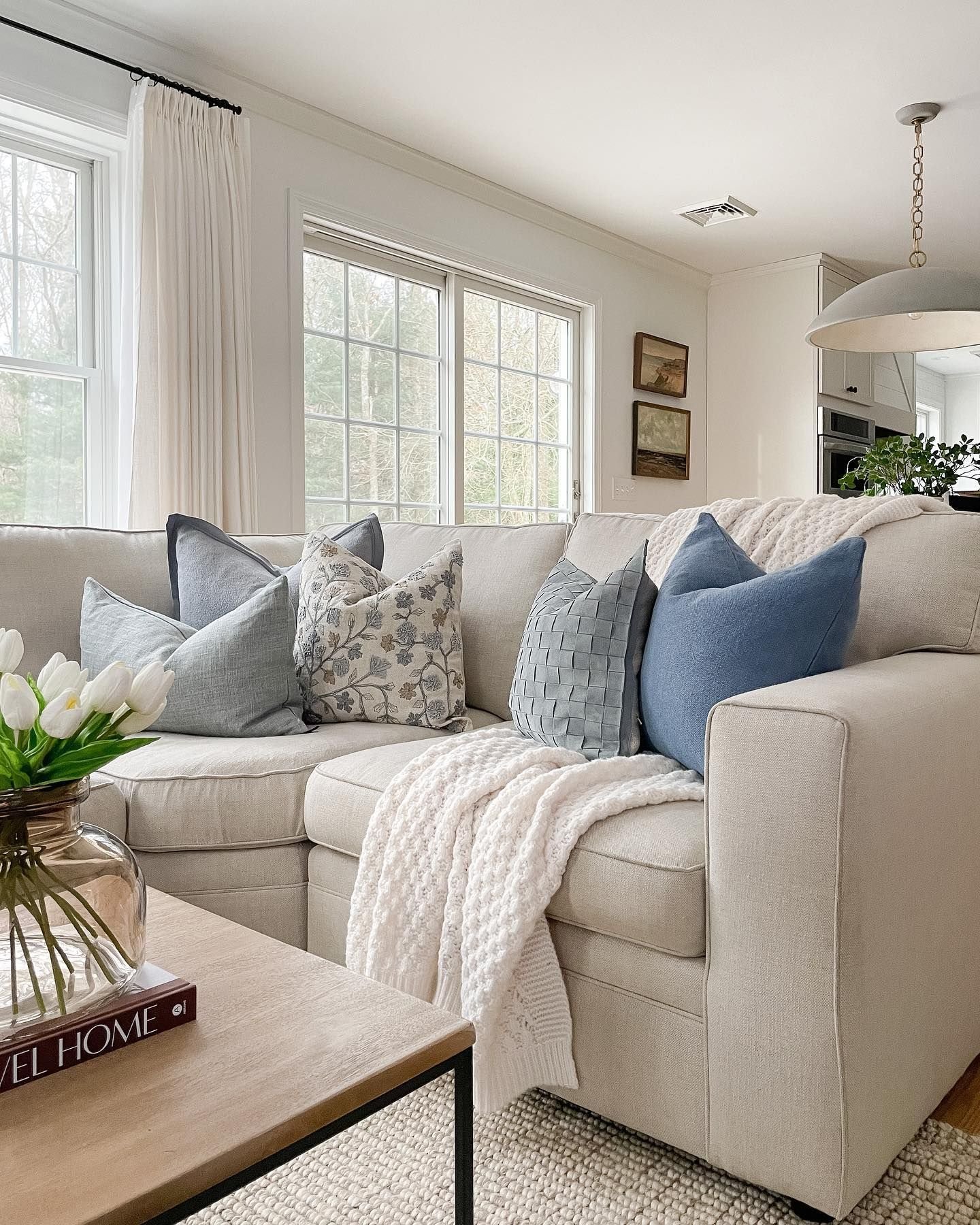
Odd numbers generate natural-feeling visual variety. Mix a velvet, a natural-fiber texture, and a patterned pillow within a consistent palette — the result looks deliberately assembled, not haphazardly gathered.
13. Dress the Chaise With a Throw
The chaise end tends to look sparse against the pillow-heavy main section. A chunky knit or woven throw draped there adds texture, weight, and the suggestion of lived-in comfort.
14. Place Lighting in the Sectional’s Corner
The inside corner where the two sectional sections connect is the ideal location for an arc lamp or a tall sculptural fixture.
It brings vertical presence, delivers indirect ambient light, and frames the seating arrangement beautifully.
15. Position Art Close to the Sofa
The guideline is 6 to 8 inches above the sectional’s back. Never drifting up toward the ceiling.
High-hung art disconnects from the furniture below. The room loses its compositional unity.
Keep art grounded to the sofa and the whole arrangement reads as intentional.
Fabric and Color Selections That Stand the Test of Time
16. Make a Statement With Color
Deep emerald, rich navy, or dramatic aubergine — a boldly colored sectional commands the room in the best possible way.
Neutral walls and warm metal accents alongside it produce a room that reads refined and deliberately styled.
17. Performance Fabric Is Practical Wisdom
Not a thrilling recommendation. But a critically important one for households with children, pets, or regular entertaining.
Performance fabrics like Crypton and Sunbrella are visually equivalent to standard upholstery. Functionally, they’re in a different league entirely.
18. A Light Sectional With Bold Cushions Is Always Striking
Light-colored sofas and active households can absolutely coexist — especially with performance upholstery — when paired with high-contrast statement cushions.
Cream sofa plus black, charcoal, or navy pillows creates something graphic and sophisticated.
19. Slipcovers Multiply Your Styling Options
A slipcovered sectional lets you rotate aesthetics with the seasons without replacing the sofa itself. Light linen for summer. Heavier, richer tones for winter.
Several looks. One piece of furniture. One lifetime investment.
Layouts Designed for Real People in Real Homes
20. Close the U With a Chair
A statement chair at the open end of an L-shaped sectional transforms an open arrangement into a full U-shape.
Every seat faces the room’s center. Conversation is natural and inclusive. No awkward outlier seats exist.
21. Trade Extra Sofa for an Ottoman
An ottoman at the open end of the sectional beats additional sofa every time for versatility. Footrest, extra seat, or — topped with a tray — an on-demand coffee table.
22. Back the Sectional With a Console
The space between a floating sectional and the wall can look like an oversight without something to fill it.
A slim console table fills that gap deliberately. Add lamps and trailing greenery and the sofa’s back edge becomes a styled moment rather than dead space.
23. Face Two Sectional Pieces Toward Each Other
When square footage allows it, two smaller sectional configurations flanking a central coffee table create an arrangement that feels simultaneously intimate and generous — ideal for entertaining.
Finishing Touches With Outsized Impact
24. Introduce Curves to Counter the Angles
Sectionals are defined entirely by straight lines and right angles.
A round or oval coffee table in front of one creates dynamic visual contrast. It’s a design pairing so reliable it’s become a classic for a reason.
25. Bring a Tall Plant Into the Arrangement
A fiddle-leaf fig or birds-of-paradise positioned beside the sectional adds organic height, softens structural edges, and animates the corner in a way no inanimate object can match.
26. Use a Picture Ledge for Art You Can Actually Update
A picture ledge above the sectional gives you infinite flexibility with wall art. Shift pieces around, introduce new finds, or change the arrangement entirely — no tools required.
The wall stays evolving and personal without permanent commitment.
27. Give the Chaise a Dedicated Surface
A side table at the arm end of the sofa is obvious. But when you’re stretched out on the chaise, that table is inaccessible.
A petite round table at the chaise end solves a real, everyday frustration most people have accepted as simply part of lounging.
28. Layer Lighting Across Three Elevations
One floor lamp at standing height. One table lamp on the console behind the sofa. A pendant or ceiling ambient overhead.
Three distinct light levels build depth, warmth, and atmosphere. Single-source overhead lighting produces a flat, clinical result regardless of how nice the fixture is.
Layer it and the room transforms entirely once the sun goes down.
29. Frame the Space With a Bench
In a generously proportioned room, a long upholstered bench positioned a short distance from the sectional draws a clear visual boundary around the seating area.
It adds structured supplementary seating for gatherings and gives the arrangement a sense of completion that floating furniture alone can’t achieve.
Start Here
You’ve just covered a comprehensive, practical set of strategies for every aspect of sectional living room design — from macro layout choices to the smallest finishing details.
Bookmark this page for reference.
The next time you stand in your living room feeling like something’s not quite right, you’ll have the vocabulary and the toolkit to understand precisely what’s off and what to do about it.
What separates a room you’re proud of from one you merely tolerate has nothing to do with how much you spend.
It has everything to do with how thoughtfully you decide.
Those decisions are now yours to make.