Disclosure : This post may contain affiliate links or paid partnerships. I may earn compensation if you click a link or make a purchase, at no additional cost to you. See my disclosure for more info.
Your front door is the jewel in your home’s crown.
Or at least, it should be.
Because right now, if you’re anything like most homeowners, it’s more of a placeholder — something you pass through twice a day without thinking, that hasn’t been updated since… well, you’d rather not say.
Here’s the thing about curb appeal that nobody talks about honestly: it shapes how you feel about coming home.
An entry you’re genuinely proud of changes your relationship with your house. You notice it. You appreciate it. It quietly tells every guest, every passerby, every delivery driver: someone thoughtful lives here.
And getting there doesn’t require a full renovation. It might require one door. Or just new hardware. Or even a single coat of paint in the right color.
Let these 43 ideas show you what’s possible.
The Art of Choosing the Right Door Color
Nothing upgrades a front door faster or more dramatically than color. The right shade turns a functional object into a design feature.
But not all bold choices are equal. These six are tried, tested, and genuinely beautiful.
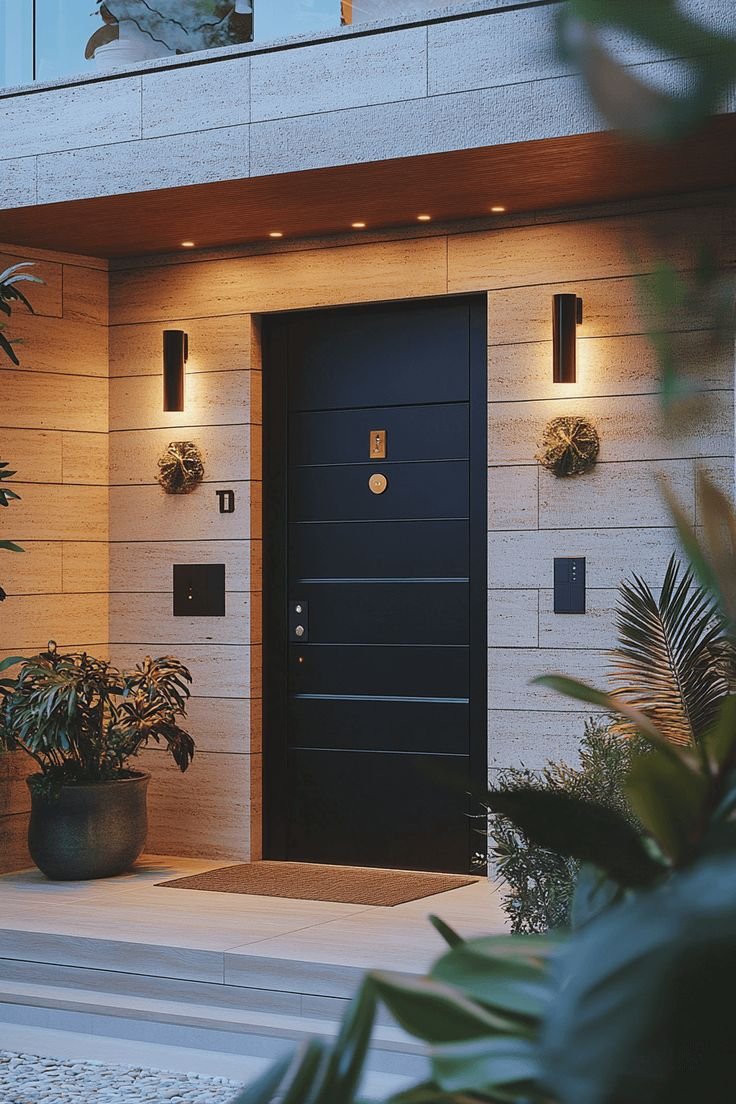
1. Inky matte black with warm gold accents. An enduringly sophisticated combination. The flatness of matte black absorbs light beautifully, and warm metal hardware introduces the perfect counterpoint.
2. Terracotta. Warm, rich, and unexpectedly glamorous. Against pale render or white weatherboard, it creates an entry that reads as artfully considered rather than showy.
3. Verdant forest green. There’s a reason this shade keeps appearing on the most beautiful homes in design publications. It harmonizes with natural materials like no other color.
4. Midnight navy. Deep, authoritative, and quietly luxurious. A satin finish gives it a surface quality that changes beautifully through the day.
5. Silvered sage. Soft without being vapid. It brings a botanical quality to the entry that feels genuinely fresh, particularly in spring and summer.
6. Graphite. The sophisticated alternative to pure black. Its warmth prevents it from reading as cold or severe, making it appropriate on a much wider range of facades.
Designer’s secret: the same color reads completely differently in morning light, afternoon sun, and shade. Paint a generous sample directly on your door and observe it across a full day before you commit to a full tin. It’s fifteen minutes that will save hours of second-guessing.
The Pivot Door: Where Architecture Meets Drama
If you want to understand why pivot doors inspire such strong reactions, stand in front of one and open it.
The movement is unlike any standard door. Slow. Deliberate. Balanced. It doesn’t just open — it presents the interior.
7. Monumental timber pivot. Grand scale and natural warmth in a single piece. These doors create an atmosphere of arrival that changes the way you experience coming home.
8. Industrial-chic steel and glass pivot. The refinement of minimal steel framing with the openness of floor-to-ceiling glazing. Light pours through. The entry transforms.
9. Frosted glass aluminum pivot. Combines the drama of pivot movement with practical privacy. A refined, contemporary choice for entries that face the street directly.
Be clear-eyed about the investment: pivot doors involve custom manufacturing, additional structural support, and specialist installation. The total cost is meaningful. But as an upgrade to your daily life and your home’s character, few changes deliver quite as much. If you love your home and plan to stay, it’s worth taking seriously.
Light and Glass: Opening Up Your Entry
Natural light is the most flattering and energizing element in any interior. A dark foyer immediately undermines the feeling of every room beyond it.
These five glass treatments address the problem beautifully.
10. Full-height glazed door with an ultra-thin frame. When your location allows it, this is the most transformative glass solution. Your foyer becomes bathed in light that shifts and changes through the day.
11. Frosted lower panel and clear upper panel. Privacy where you need it, openness above. An elegant functional solution that’s been used in residential design for generations.
12. Paired sidelights flanking the door. One of the most versatile light solutions: you keep your existing door and simply add glass panels on either side. The entry is immediately transformed.
13. Wide transom above the frame. Natural light arriving from above is the most beautiful kind. A deep, wide transom is a classic architectural detail that’s just as relevant in contemporary residential design.
14. Reeded or fluted glass panel. The textured surface scatters light in the most appealing way — soft, warm, and decorative. It’s currently one of the most desirable glass treatments in residential interiors.
Glass and privacy: consider your entry from the outside at both day and night. A door that feels private during daylight (when the interior is darker than the exterior) may read as completely transparent at night when the interior is lit. If you have any doubts, choose obscure or textured glazing.
The Beauty of Modern Timber Doors
Contemporary timber doors represent the finest point of intersection between natural beauty and modern craft. They warm an entry in a way that painted or composite doors simply cannot.
15. White oak with a perfectly flush face. The subtlety of the grain, the warmth of the tone, and the cleanliness of the flush surface create something genuinely beautiful.
16. Black walnut with edge-banding detail. Few materials carry the visual weight of American walnut. Its deep tones and varied grain create an entry that commands attention without demanding it.
17. Teak with decorative horizontal banding. The banding adds a layer of tactile richness to an already beautiful material. Teak’s natural oils make it perfect for the demands of exterior exposure.
18. Blonde maple with clean Scandinavian lines. Light, airy, and restrained. The design language of Scandinavia — which has never really been bettered for understated elegance — translated into a front door.
19. Reclaimed hardwood in a modern profile. The patina and texture of aged, salvaged timber within a contemporary geometric form. Material history meets architectural present.
Timber requires care. That’s not a flaw — it’s the nature of a living material. If you’re prepared to offer that care, a properly maintained wood door will reward you with a beauty that only deepens over time. If you’re not, a high-quality fiberglass alternative with a convincing timber finish is an honest choice.
Hardware: The Finishing Touch That Makes Everything
In interior design, we talk about accessories as the thing that makes an outfit. Front door hardware is exactly that — the finishing detail that takes a good door and makes it a great one.
20. A beautifully proportioned lever in matte black. Clean, architectural, and available at a price point that makes it accessible to almost everyone. Replace your dated knob this weekend.
21. An elongated bar pull in brushed brass. The piece that single-handedly shifts a door from functional to designed. Scale is everything here — go longer than you think you need to.
22. A refined keypad entry system. The best current models are slim enough to be architectural elements in their own right, rather than afterthoughts bolted onto the door face.
23. Generously scaled door numbers. In a contemporary sans-serif typeface, in a size large enough to be read from the street. This detail often makes more difference than people expect.
24. An integrated letter aperture. For entries that lean towards European or mid-century character, a recessed letter plate is the detail that says “every element here was considered.”
And please — don’t forget the hinges. Matching your hinge finish to your lever finish is the kind of detail that reveals a considered approach to the whole entry, not just the obvious parts.
If you’re only doing one thing to your current entry, update the hardware. It’s the fastest, most affordable upgrade available — and it invariably makes people ask whether you changed the whole door.
Double Doors: An Entry That Announces Itself
Double doors have an innate generosity. They suggest that what’s inside is worth welcoming people to. That arrivals here are occasions.
25. Steel-framed glazed French doors. The thin steel lines create a graphic, architectural quality. Natural light floods the foyer. The view from inside out is as beautiful as the view from outside in.
26. Double timber doors with pivot hardware. Combining two of the most dramatic entry elements — double leaf and pivot movement — creates something genuinely memorable.
27. Arched double doors with textured glass. The softness of the arch balances the weight of the double-leaf format. Fluted or reeded glass inserts add contemporary texture to a classically shaped opening.
28. Unequal-leaf double doors. The asymmetry creates visual interest and practical sense. Daily use via the wider panel; full opening for entertaining or moving large pieces.
Please confirm your structural situation before ordering. Widening an existing opening to accommodate double doors requires an engineer’s assessment and appropriate structural support above the opening.
Minimalism: The Power of the Well-Resolved Entry
The most considered entries are often the quietest. They don’t shout for attention. They reward it.
29. The truly invisible door. Perfectly flush, seamlessly detailed, sitting level with the surrounding facade. For a moment, you wonder whether there’s a door there at all. Then it opens.
30. The handleless door. No lever. No pull. A completely clean surface with a discreet push plate. Requires confidence in the design but pays off beautifully when the context supports it.
31. The camouflage entry. Door and surrounding wall in an identical finish — same color, same texture, same sheen. The entry becomes a visual puzzle that resolves into something architectural and sophisticated.
32. Solid door with a single vertical aperture. A narrow strip of glass set into an otherwise unbroken surface. The proportion of void to solid is the entire design. Adjust until it’s right.
33. Raw concrete-finish panel door. The ideal choice for homes with an industrial or brutalist character. A texture that is simultaneously humble and deliberate.
Minimal design is demanding. Every element that remains must be precisely right. There is nowhere to hide imprecision. But when it succeeds — and it does — it’s the most beautiful approach of all.
Mid-Century Modern Doors: Design That Has Always Been Contemporary
The genius of mid-century modernism was always that it looked forward. The best examples remain as fresh now as they were when first designed. They don’t feel retro — they feel ahead of their time.
34. Graphic geometric panels. The era’s love of geometry translated into door panels. Stars, diamonds, elongated rectangles — each brings a visual energy that contemporary design rarely achieves.
35. A vivid statement door with a period-perfect knocker. If your home has the character to support it, a bright, unapologetic color on the front door is one of the most joyful things you can do.
36. Plank door in period teal. The color that defines the era. With contemporary-scale house numbers and the right hardware, this creates an entry that is both historically informed and genuinely current.
37. Square-window panel door. Three squares, stacked vertically, in perfect proportion. A design solution so resolved that it requires no decoration — the geometry is the beauty.
For homes with original mid-century DNA, embracing the architectural vocabulary of the period is usually the most confident choice. These are buildings that were designed to be beautiful. Respect their language.
Entry Surrounds: Completing the Composition
A beautiful door in an unresolved surround is a sentence without a conclusion. The entry needs to be designed as a whole.
38. Vertical cladding as an entry feature wall. Extending panel detail around the door frame creates a visual anchor for the facade. The entry stops being just a door and becomes a composition.
39. Natural stone or large-format tile surround. The introduction of a material with texture, mass, and permanence changes the character of an entry entirely. Stone reads as inherently considered.
40. Bold contrasting trim and architrave. The oldest trick in facade design. A dark surround on a pale facade makes the entry the clear focal point of the elevation.
41. Designed planting recesses flanking the entry. Integrating greenery into the entry design rather than adding planters as afterthoughts produces a composed, finished quality.
42. A covered threshold with curated lighting. A recessed entry creates a covered threshold space that is genuinely inviting. Add a considered pendant or architectural downlight and your entry is transformed after dark into something atmospheric and beautiful.
43. The right entrance mat. Generously scaled, well-made, in a color and texture that complements rather than competes with the door. This is the final detail that completes an entry that has been thoughtfully considered from the street all the way to the threshold.
Your Next Step
Forty-three ideas. An entry that deserves to be beautiful. The only question now is where to begin.
Start with what bothers you most about your current situation. Color, hardware, light, proportion — whatever your answer, there is a solution on this list that addresses it.
Choose one thing. Commit to it. Do it well.
The most beautiful homes are built one considered decision at a time. Your front door is one of the best decisions you can make this season.