Disclosure : This post may contain affiliate links or paid partnerships. I may earn compensation if you click a link or make a purchase, at no additional cost to you. See my disclosure for more info.
You’re working with what you’ve got.
Maybe it’s a compact apartment. Maybe it’s a room with an odd shape. Maybe it’s just a space that never quite looks right no matter what you put in it.
You’ve tried the standard advice: declutter, add mirrors, use lighter colors, get a rug. You know all of it.
And the room still feels smaller and less resolved than you want it to be.
Here’s what nobody is mentioning in those articles:
The way you select and place chairs determines whether a living room feels spacious or cramped, composed or chaotic, designed or merely furnished.
Chairs take up more visual territory than almost any other element in the room. The wrong chair — in the wrong place — can make a generous room feel tight. The right chair — placed with intention — can make a compact room feel considered and complete.
These twenty-seven tips are specifically about getting that right — regardless of how much square footage you’re working with.
Form and Scale: Choosing Chairs That Work With Your Space
1. Always measure before you fall for a chair online.
Photos are optimistic. A chair photographed in a sprawling showroom looks smaller in scale than it actually is.
Before ordering anything, tape the precise footprint on your floor. Walk around it. Check sightlines from doorways. If it dominates the taped area, it will dominate the room. Buy accordingly.
2. Introduce one curved chair to offset a rigid, angular room.
When every element in a space is a right angle — rectangular sofa, square shelves, boxy media unit — the eye has nowhere comfortable to rest.
A single barrel or rounded-back chair disrupts the pattern. The room immediately softens. The effect is larger than the change suggests.
3. Use low-profile chairs to push the ceiling higher visually.
When chairs sit low, the vertical space above them expands in the eye’s perception. In rooms where ceiling height is ordinary or below average, this optical adjustment genuinely helps.
Consider swapping any tall-backed accent seating for lower, more streamlined forms if the ceiling feels oppressive.
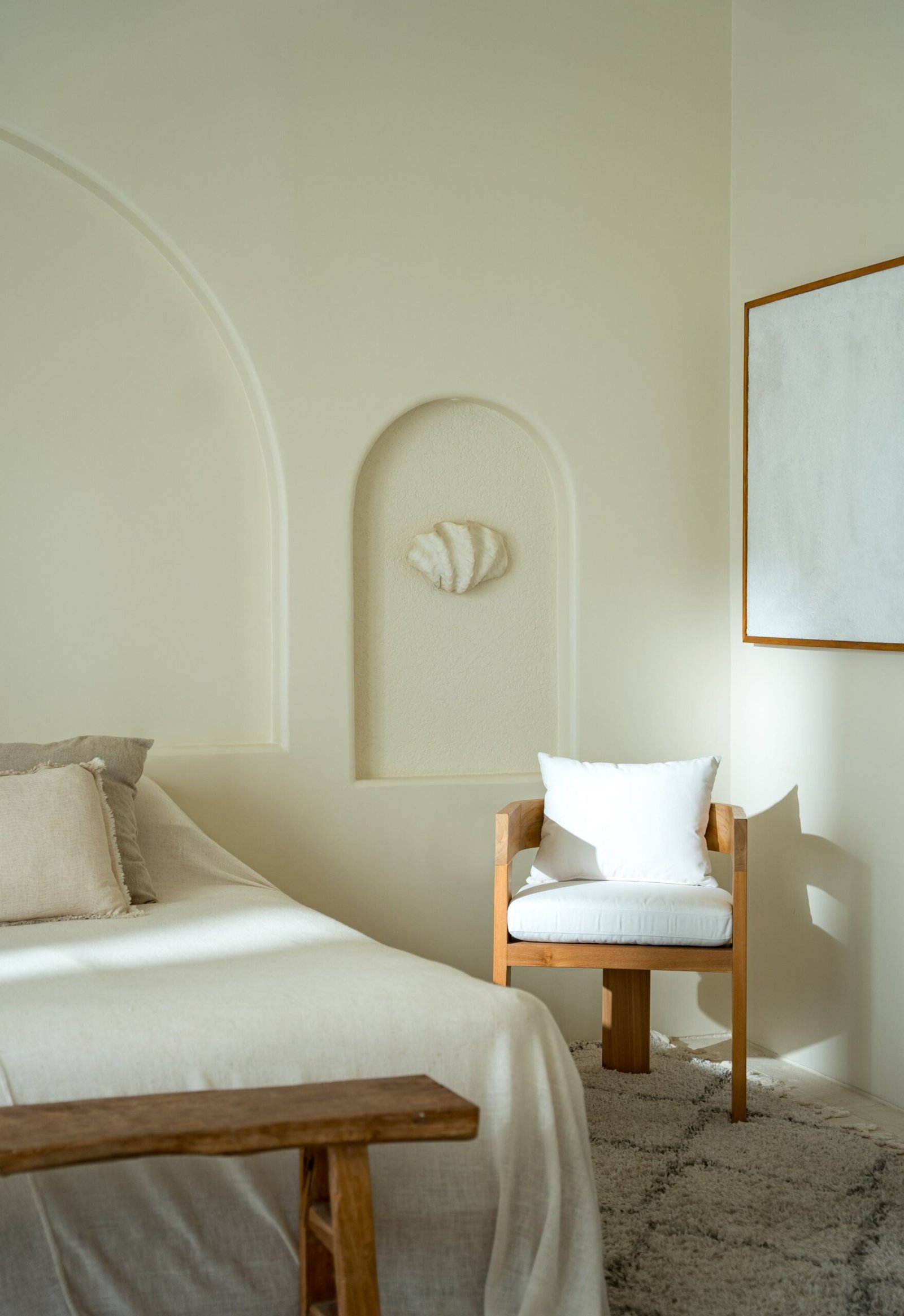
4. Choose chairs whose legs expose the floor.
In compact rooms especially, visible floor reads as open space. A chair with slim, open legs — metal, tapered wood, hairpin — contributes to that openness.
Fully upholstered or skirted chairs do the opposite: they read as mass and weight, visually compressing whatever is around them.
5. Anchor the room with one intentionally large statement chair.
Counterintuitively, one properly scaled large chair can make a small room feel larger. The trick is that it implies the room can hold something that generous, which creates a sense of sufficiency.
A deliberate wingback or club chair works here. Something chosen for the space — not forced into it.
Color and Material: Making a Small Room Feel Rich
6. Break the habit of matching chairs to the sofa.
When everything is the same tone, the room flattens. There’s no visual movement, no depth, no sense of layers.
Contrast does the opposite. A chair in a deeper or warmer tone beside a neutral sofa creates visual dimension. The room looks more complex, more considered, and often larger as a result.
7. Use surface texture to add richness when the color palette is quiet.
In small rooms, a loud color palette can feel overwhelming. A bouclé chair in soft white or a velvet accent seat in warm gray creates depth without adding visual noise.
The palette stays unified. The room gains layered richness through material variation alone.
8. Invest in performance fabric for busy, real-life rooms.
In a small living room, any stain or wear on a chair is immediately visible. There’s nowhere for it to hide.
Performance upholstery protects the appearance of the room without limiting material choices. Modern versions are visually indistinguishable from standard fabrics — the difference is in durability and peace of mind.
9. Use one chair to introduce deliberate, considered color.
Even in a small room — especially in a small room — one piece in a strong, intentional color has an outsized effect.
It becomes a focal point. It draws the eye. It makes the room look designed rather than assembled. Choose the color carefully, commit to it, and let everything else support it.
10. Consider a leather chair for warmth and lasting quality.
A leather armchair in a warm, medium tone adds organic depth to the room without adding visual weight the way a dark, matte fabric would.
Leather also develops character over time. In a room that’s used daily, that’s a feature worth paying for.
11. Check what the back of every floating chair looks like.
In a compact room, chairs pulled away from the wall are visible from all sides. A flat, featureless chair back is a missed opportunity. One with visible structure or craft detail — an exposed wood frame, a sculpted back curve — works as a design element from every angle.
Placement: Using Chair Position to Expand Visual Space
12. Move every chair away from the walls.
The instinct to push furniture to the perimeter is understandable in a small room. It seems like it would create more central space.
It actually does the opposite. Furniture clustering against walls empties the center and makes the room feel like a corridor. Pulling chairs inward, even slightly, creates a zone — and zones make rooms feel purposeful and complete.
13. Angle chairs to create a defined conversation area.
Two chairs aimed at thirty to forty-five degrees toward the sofa form a seating cluster that visually anchors the room. Without a defined conversation zone, the space feels loose and unresolved, which reads as smaller than it is.
14. Use one chair to create a dedicated reading spot.
One armchair, a compact side table, and a floor lamp in a corner. This reading nook gives the small room a second zone — and two zones make a room feel larger than one zone does, even in identical square footage.
15. Anchor a fireplace with a symmetric pair of chairs.
Symmetry around a fireplace creates instant formality and architectural presence. Even in a small room, this arrangement reads as larger and more resolved than an asymmetric or informal layout would.
16. Use one chair to mark zone boundaries in open-plan spaces.
When a small apartment’s living area flows directly into a dining space, a single well-placed chair at the edge of the seating group creates a visual boundary without reducing usable space. Effective zoning makes both areas feel more intentional and complete.
17. Point your best chair at the room’s most interesting feature.
A window. A view. A beautiful piece on the wall. The spot where the light is best in the late afternoon.
Orienting a chair toward that feature gives the room a visual reason for being. In small spaces especially, purpose is what separates charming from cramped.
Small Changes That Make Chairs Look More Expensive
18. Swap the legs on any chair that feels like it’s punching below its weight.
Budget chairs often have generic, uninspired legs that signal their price point immediately.
Replace them with walnut tapers, brass-capped feet, or powder-coated metal. The operation takes minutes and costs very little. The perceptual upgrade to the chair — and therefore the room — is significant.
19. Style each accent chair with one carefully chosen pillow.
One lumbar throw in a material that contrasts with the chair — not matches it. Textured against smooth. Warm tone against cool. One pillow is styling. Four pillows is clutter. In small rooms, clutter is the enemy.
20. Look for chairs with visible, considered details.
Nail-head borders. Exposed frame joinery. A distinctive stitching pattern. These craft signals matter disproportionately in small rooms — every surface is seen up close. Quality details make a small room feel carefully considered, not compressed.
21. Include at least one chair with a sculptural, distinctive profile.
In a room where every piece is conventional and rectangular, one chair with genuine visual character — an unusual back form, a continuous curve, an architectural silhouette — creates interest without requiring additional square footage. It becomes the conversation piece the room was missing.
Practical Choices for Rooms That Get Real Use
22. A swivel chair is particularly valuable in multipurpose small rooms.
When a compact living room also serves as a home office, media room, and social space, a swivel chair adapts to every function without changing the layout.
It’s the most spatially efficient seating choice for rooms that need to do multiple things.
23. Pair one chair with an ottoman to create a lounge zone.
Even in a small room, a chair-and-ottoman pairing creates a zone that reads as generous and intentional. The ottoman can double as a coffee table or extra seating, adding functional versatility while contributing visual mass that makes the room feel furnished rather than sparse.
24. Keep a throw draped over one chair arm at all times.
In small rooms especially, bare furniture can look unfinished. A casually folded throw over one arm provides instant warmth, texture, and visual completion. It signals comfort. It invites use. It costs almost nothing to maintain.
Errors That Make Small Rooms Feel Even Smaller
25. Don’t include any chair that doesn’t get used.
Decorative chairs that nobody sits in are a particular liability in small rooms. They take up real space while contributing nothing functional.
Every chair in a compact living room should be comfortable enough that people actually choose to sit in it. If it isn’t, it’s wasting the room’s most precious resource: square footage.
26. Verify seat depth works for everyone who will use the room.
In small rooms, chairs often sit closer together than standard spacing guidelines suggest. An overly deep chair that requires propping or awkward posture becomes an active problem in that configuration.
Seat depth should support natural posture for your household’s range of heights. Test it before purchasing, not after delivery.
27. Rotate chairs seasonally to prevent visual stagnation.
A small room with unchanging furniture can feel suffocating by mid-year. You don’t need to buy new pieces — just rotate.
A light woven chair for summer, a velvet piece for winter — the room stays seasonally alive and never becomes something you stop seeing.
The Size of the Room Isn’t the Problem
Here’s what these twenty-seven tips are really pointing toward:
The size of the room is rarely the actual constraint. What limits most living rooms is the absence of intentional chair decisions — decisions about scale, placement, material, contrast, and purpose.
Make one of these decisions well, and the room responds.
Make several, and the transformation is visible.
Start with whichever tip costs nothing. Pull a chair away from the wall. Angle it toward the conversation. Drape a throw. Take stock of what the legs look like.
One change this weekend. Another next weekend.
The room you’ve been wishing you had is already there. The chairs are the key to unlocking it.