Disclosure : This post may contain affiliate links or paid partnerships. I may earn compensation if you click a link or make a purchase, at no additional cost to you. See my disclosure for more info.
There’s a reason your living room doesn’t feel finished.
And it’s probably not the walls, the lighting, or the sofa arrangement.
It’s the table sitting in the dead center of everything.
The one you’ve been ignoring. The one that technically works but does absolutely nothing for the room. The one you stop noticing precisely because it contributes nothing worth noticing.
That table is the problem. And it has an incredibly straightforward solution.
The center table occupies the most visible real estate in your living room. It’s where eyes land when people walk in. It’s what guests register first. It’s the reference point everything else in the room orients around.
A table that earns that position makes the entire room feel curated. A table that doesn’t — drags everything else down with it, quietly, constantly.
Below are 29 designs worth upgrading to. Not concept boards. Not aspirational mood images. Actual tables you can find, buy, and install. Each one chosen because it actively improves the room it enters.
Read through. Trust the one that clicks.
Marble and Natural Stone: The Reliable Route to Understated Luxury
1. White Carrara Marble Round Table
Classic round form. Carrara marble top. Slender base in brushed metal.
There’s a reason Carrara marble has been a design standard for centuries — it photographs beautifully, ages well, and adapts to every surrounding it finds itself in. The round form prevents any directional awkwardness in the room.
The trade-off: marble requires maintenance. Seal it. Use coasters. Accept that character and patina will develop over time.
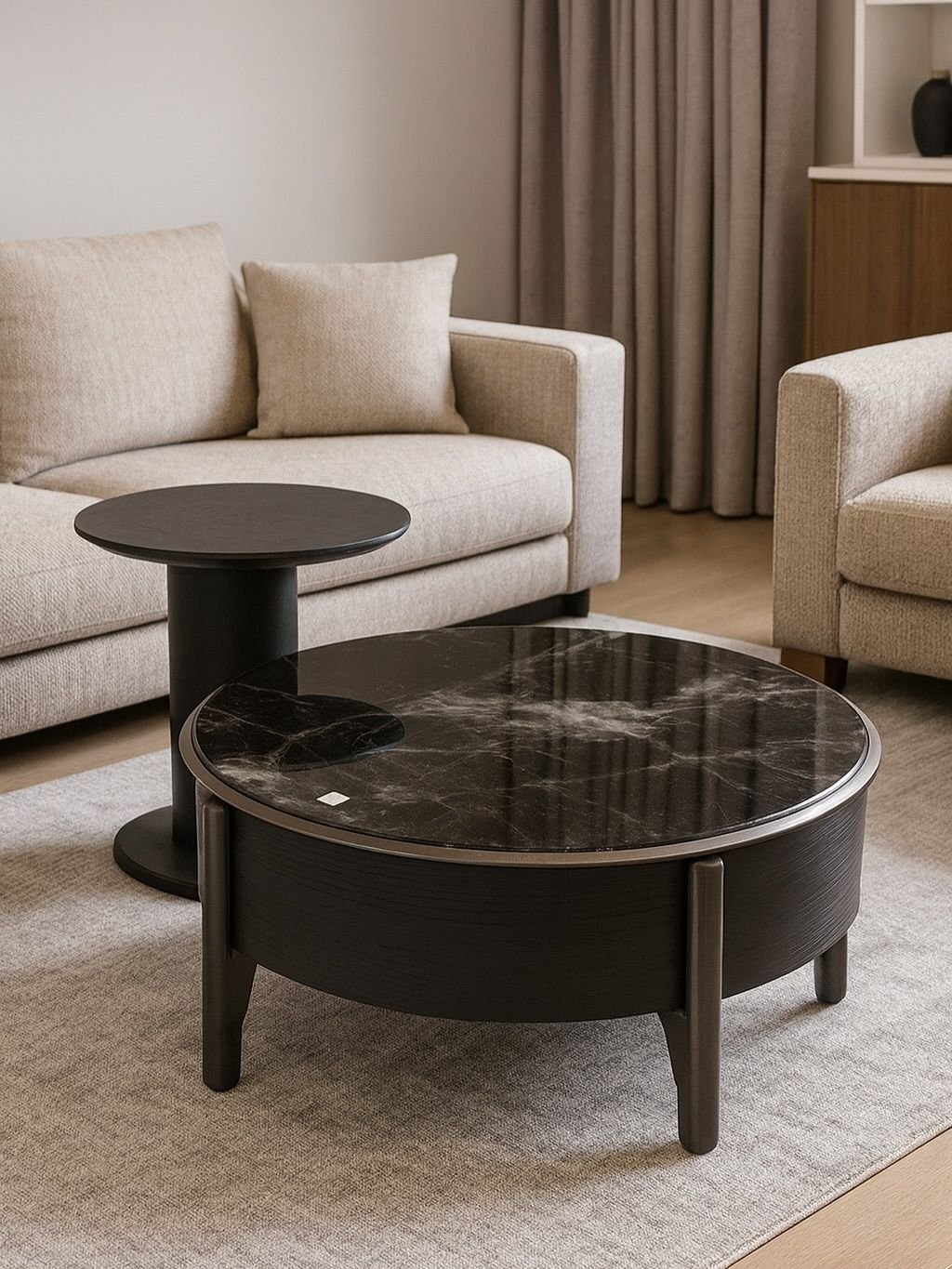
2. Nero Marquina Black Marble Oval
Black stone, white veins, oval silhouette.
For rooms that trend toward light and neutral, Nero Marquina is the intervention that creates depth. The oval shape prevents the table from feeling overwhelming — a rectangle of this material would stop a room cold. The oval moves with it.
3. Travertine Drum Table
Warm, porous stone. Cylindrical monolithic form. No legs, no frame, no fuss.
Travertine works in spaces that want to feel connected to natural materials — earthy, warm, grounded. The drum silhouette is of-the-moment without being a trend piece. It’ll still look appropriate five years from now.
4. Terrazzo Pedestal Table
Multi-toned stone composite. Polished surface. Clean pedestal base.
Terrazzo is perhaps the most underused upscale material in residential furniture. It provides genuine color and pattern in a format that reads as considered rather than decorative. It’s playful and restrained simultaneously — a difficult effect.
Glass Tables: Transparency as a Design Strategy
5. Tempered Glass on Brushed Gold Base
Clear tempered surface on a warm geometric metal base.
Visual weightlessness is the primary value of a glass table — the room can breathe around it. The brushed gold base adds warmth that polished alternatives can’t: matte finishes read as luxurious; shiny finishes read as trying.
6. Smoked Glass Oval
Grey-tinted glass. Slightly opaque. Dramatically more fingerprint-resistant than clear alternatives.
Smoked glass occupies a useful middle position — lighter than a solid table, more forgiving than clear glass, with a moody quality that suits rooms with more contrast and drama in their palette.
7. Clear Glass Over Walnut Shelf
Clear top. Walnut display tier below. Two materials, two functions, one coherent object.
The genius of this design is that it solves the top-surface-clutter problem by design: the glass top stays clean (everything important sits below), while the walnut shelf provides a curated display platform visible through the transparent surface.
Solid Wood: The Heirloom Option
8. Live-Edge Walnut Slab
Raw natural edges preserved. Walnut grain in deep, complex tones. Statement base.
The live-edge is the furniture world’s answer to individuality. The tree dictates the shape. No two slabs share an identical edge. The piece you buy is the only one of its kind — which is a genuine and increasingly rare thing to own.
9. Japanese-Inspired Low Oak Table
Platform height. Oak finish. Stripped of everything unnecessary.
The philosophy of ma — the Japanese concept of intentional empty space — is embedded in this table’s proportions. It takes up exactly as much visual space as needed, and not one centimeter more. In rooms that feel overcrowded, that restraint is transformative.
10. Dark Stained Pedestal Round Table
Turned column pedestal. Circular top. Espresso or ebony stain.
Traditional pedestal forms have survived centuries of furniture trends for a reason: they provide visual stability without heavy visual weight. The single column reads as delicate. The round top reads as welcoming. Together they work in rooms that want elegance without formality.
11. Reclaimed Teak Rectangle
Salvaged teak with its full history still readable in the grain and tone variations.
Teak is among the most durable hardwoods on earth — its natural oils resist moisture, insects, and warping better than virtually any alternative. Reclaimed teak brings that durability plus a visual character that new wood simply cannot replicate.
Metal-Dominant Designs: Hard Edges, Strong Personality
12. Hammered Brass Drum
Hand-textured brass. Cylindrical form. Infinitely varied light response.
The hammering process makes each table subtly different — the texture is never perfectly uniform. Combined with brass’s natural light-catching properties, the result is a surface that shifts appearance continuously throughout the day.
13. Blackened Steel and Raw Concrete
Industrial materials handled with precision rather than roughness.
The key to making this work in a residential space: contrast it against yielding materials. Soft leather, heavy linen, thick wool — the severity of the steel and concrete needs something to lean against. That contrast is where the beauty lives.
14. Mirror-Finish Stainless Steel Cube
Polished stainless. Perfect geometric cube. Reflects everything, is defined by nothing.
This table is an argument about space rather than a piece of furniture. It borrows the identity of whatever surrounds it, then gives it back doubled. In a carefully designed room, that effect is extraordinary.
15. Antique Bronze Sculptural Base
Organic cast-bronze base forms. Simple round top that deliberately recedes.
The designer’s intention here is legible: the base is the object, the top is the surface. Everything is subordinate to the sculptural quality of the base. Patina will develop over time, increasing rather than diminishing its visual presence.
Multi-Tier and Configurable Tables: Versatility as Elegance
16. Two-Tier Round Table With Open Shelf
Main surface on top. Open storage level below. Both levels function as display opportunities.
The dual level solves the problem of a coffee table that’s either too styled to use or too used to look styled. The top tier is for display. The bottom tier is for reality — the books, the remotes, the things a room actually needs to function.
17. Nesting Table Set
Multiple pieces at different scales, designed to nest compactly or spread into a larger surface system.
Nesting tables are a spatial intelligence solution. Closed, they take up minimal floor area. Open, they create a flexible surface arrangement that accommodates guests, work sessions, or any other temporary need.
18. Tiered Glass and Marble
Glass at the upper level. Marble at the lower. Two materials creating visual rhythm between heights.
The tiered structure is fundamentally more interesting than a single flat surface because your eye moves through it rather than across it. The material contrast reinforces the spatial contrast. Both effects work simultaneously.
Sculptural One-Offs: Tables That Double as Objects
19. Freeform Resin Table
Cast resin in organic, non-repeating forms. Clear or richly pigmented.
The resin casting process preserves a moment — the exact state of the material as it was poured. No two results are identical. What you’re buying is both a functional table and an artifact of a specific material moment.
20. Glazed Ceramic Hourglass
Single ceramic form. Hourglass silhouette. Matte glaze in rich, saturated color.
Ceramic furniture sits in an interesting space — it has the permanence of stone, the warmth of earthenware, and a handmade quality that mass-produced materials cannot replicate. This one in particular brings both color and curve to rooms that need both.
21. Faceted Geometric Hardwood
Hardwood carved into angular facets. Shadow lines define the geometry.
Unlike standard furniture that looks the same at 9 AM as it does at 9 PM, a faceted piece is genuinely light-dependent. The facets capture and reflect light differently at every hour, making it a different visual experience throughout the day.
Compact Designs for Rooms Where Every Inch Is Negotiated
22. Slim Oval Marble-Top Table
Low-profile oval with a full-quality marble surface at smaller scale.
There’s no version of interior design where small spaces have to accept inferior materials. This table puts Carrara marble on the center floor of a compact living room without consuming the space. Both things at once.
23. Compact Pedestal Round Under 30 Inches
Sub-30-inch footprint. Pedestal base. Zero leg protrusion.
Apartment living has produced its own design solutions over decades, and the compact pedestal round table is one of the best. It maximizes surface area relative to floor footprint, and the column base means no wasted floor space beneath protruding legs.
24. Transparent Acrylic Table
100% transparent. No visual footprint whatsoever.
For rooms where every surface and every material choice compounds into something that feels either spacious or claustrophobic, a transparent table removes itself from the equation completely. It contributes function without contributing visual weight.
Mixed-Material Tables: Designed on the Tension Between Opposites
25. Reclaimed Wood on Forged Iron Frame
Organic salvaged surface. Rigid industrial base. The interplay of warmth and weight.
Material contrast creates visual interest that single-material tables fundamentally cannot achieve. This particular contrast — rough organic wood over precise iron — reads as confident rather than arbitrary because both elements are treated with equal intention.
26. Marble Top With Rattan-Wrapped Base
Polished stone surface. Handwoven natural base.
The material conversation here is global: European stone meeting Southeast Asian craft. The aesthetic result is a piece that bridges formal and relaxed effortlessly — appropriate in a beach house or a Manhattan apartment, equally at home in both.
27. Leather-Wrapped Surface With Metal Trim
Full-grain leather top surface with contrasting metal edge trim.
Leather as a tabletop material is still genuinely rare in residential design — which gives it immediate distinction. The surface develops patina rather than wear. Five years from now it will look more refined, not less.
Functional Designs That Handle Real Living Without Sacrificing Aesthetics
28. Lift-Top Wooden Table
Top surface lifts to reveal concealed interior storage. Counterweighted for smooth operation.
The best design solutions are the ones that appear simple but solve complex problems invisibly. This table looks like any other attractive wood coffee table until the moment you need it to be something else. Then it becomes a storage system. Then it closes and goes back to being a table.
29. Mid-Century Drawer Table With Tapered Legs
Tapered solid legs. Integrated drawer. Mid-century proportions precisely maintained.
The drawer is the utilitarian core; the rest of the design is pure aesthetic confidence. Tapered legs, flush drawer face, honest joinery — this is a table that takes the mid-century vocabulary seriously and delivers it without nostalgia. It looks current and timeless at once.
The Decision Framework: From 29 to 1
Twenty-nine genuine options is more than most people need. Here is the efficient path to your answer.
First: sofa geometry. Sectional → round or oval. Straight sofa across from chairs → rectangle. Open arrangement → round.
Second: room material palette. Wood dominant → introduce glass or metal as counterpoint. Neutral throughout → this is the table’s moment to add material interest.
Third: your actual daily frustration. Clutter accumulation → storage table. Cramped feeling → slim or transparent. Visual boredom → sculptural or mixed-material.
Work through those three honestly and the field of 29 collapses to a manageable shortlist. Then pick the one that made you pause longest.
The Sizing Calculation That Prevents Expensive Regret
A wrong-sized table negates every good decision you make about style, material, and form. This is the one technical rule worth memorizing.
Length: approximately two-thirds the length of the longest sofa in the arrangement. Height: at or just below the seat cushion surface of the sofa.
Under-sized: the table reads as an afterthought, floating in a void of negative space. Over-sized: movement through the room becomes frustrated, the table dominates at the expense of everything else.
Measure before purchasing. Not as a formality — as a requirement.
The Move Is Yours
You’ve just reviewed 29 substantive center table options. Somewhere in that review, something shifted — a design that didn’t feel like a design decision so much as an obvious answer.
Follow that recognition.
The gap between a living room that works and one that impresses is often a single furniture decision. You’re standing at that decision right now.
Measure your space. Confirm your proportions. Order the table.
Your living room has been waiting for this moment. Time to give it one.