Disclosure : This post may contain affiliate links or paid partnerships. I may earn compensation if you click a link or make a purchase, at no additional cost to you. See my disclosure for more info.
There’s an unfinished quality to the room.
You can feel it even if you can’t name it. That sense that the space hasn’t fully committed to its own identity. Something is missing — specifically, vertical structure and a reason for the eye to settle.
What’s missing is a bookcase. The right one.
Interior designers understand something most homeowners don’t: a bookcase is not just furniture. It is vertical architecture. It creates rhythm on a wall, defines zones within a room, and — when chosen with precision — elevates everything around it.
The problem isn’t a shortage of options. It’s an abundance of them, most of them wrong for any given space.
These 25 contemporary bookcase ideas solve that problem. Each one is chosen to deliver real design impact in a specific context.
The Architecture of a Well-Chosen Bookcase
Before examining specific styles, it’s worth understanding what a bookcase actually does to a room.
Furniture placed on the floor anchors the horizontal plane. A bookcase engages the vertical plane — the walls, the height, the space between floor and ceiling that most home furnishing decisions completely ignore.
When a bookcase succeeds, it doesn’t just hold objects. It activates the wall, brings proportion to the room, and creates what designers call a “rest point” — somewhere for the eye to land and feel satisfied.
When it fails, it either disappears or creates visual noise. The following 25 options are designed to succeed.
Structurally Light Open-Shelf Formats
1. Cantilevered wall-mounted cube shelving
Cantilevered wall-mounted cube shelves preserve the floor plane entirely, creating the impression of objects floating against the wall. In compact interiors, this visual lightness is genuinely space-expanding.
Configured in a staggered arrangement, they also function as an effective room partition without obstructing light.
2. The inclined ladder bookcase
The ladder bookcase is one of the most spatially efficient shelving formats available. Its tapered, leaning form occupies minimal floor space while presenting considerable vertical storage.
Its casual geometry introduces an informal note that balances well against more structured furniture pieces.
3. Asymmetric staggered-shelf unit
Variable shelf heights and widths prevent the visual monotony of standard grid-pattern shelving. The irregular rhythm engages the eye, creating dynamic interest without introducing disorder.
This format generates conversation precisely because it defies expectation while remaining entirely functional.
4. Vertical single-column tower bookcase
A tower bookcase is the most effective tool for activating a narrow or underused corner. Its strong vertical emphasis directs the eye upward, which optically increases perceived ceiling height — a technique used consistently in well-designed small-space interiors.
Structural Focal Points and Furniture Architecture
5. Mid-century modern bookcase on splayed legs
The mid-century modern bookcase represents a convergence of craft and proportion that has sustained its relevance for seven decades. Splayed legs, warm timber surfaces, and restrained detailing produce a piece that integrates naturally across contemporary, transitional, and eclectic interiors.
6. Industrial geometric steel-frame bookcase
The juxtaposition of structural steel framing and warm timber shelving is a signature of industrial-modern design. The geometric precision of the frame and the offset shelf arrangement create a composition that reads as much as sculpture as it does as storage.
This format renders adjacent wall art redundant.
7. Arched-form bookcase
The arch has re-entered contemporary interiors as a counterpoint to the dominant rectilinear geometry of modernism. An arched bookcase introduces organic softness while maintaining a clean, current silhouette.
In rooms furnished with sharp-edged pieces, it provides essential visual relief.
8. Glass-and-metal display cabinet
When the objects on display have intrinsic visual merit — ceramics, sculptural pieces, carefully edited books — the case itself should frame rather than compete. Glass-panel construction achieves this while protecting contents and creating the elevated atmosphere of a gallery vitrine.
Freestanding Approaches to the Built-In Aesthetic
9. Floor-to-ceiling frameless bookcase
Custom joinery is prohibitively expensive for most budgets. A tall, frameless freestanding bookcase placed flush to the wall, finished in the wall’s own color, produces a convincing facsimile at a fraction of the cost.
The technique is well-established among professional designers working with constrained budgets.
10. Symmetrically paired bookcases flanking a fireplace
Bilateral symmetry around a fireplace axis creates one of the most reliably successful compositions in residential interior design. Two matched bookcases achieve this effect without structural modification, transforming the fireplace wall into the room’s clear architectural centerpiece.
11. Illuminated alcove bookcase
A recessed nook fitted with a slim bookcase and a concealed LED strip behind the top shelf produces both ambient light and atmospheric focus. Lighting elevates the alcove from storage to feature — a distinction that dramatically affects how the room reads at evening.
Space-Optimized Solutions for Compact Interiors
12. Corner-filling bookcase
Corners are structurally and visually inert in most rooms. A corner bookcase activates both dimensions of the junction, reclaiming floor area that standard furniture cannot access while creating an unexpected point of design interest.
13. Low sofa-back console bookcase
The zone behind a freestanding sofa is typically dead space. A low-profile horizontal bookcase positioned there fills the gap functionally — providing display surface on top and storage for baskets and books within — without obstructing circulation or sightlines.
14. Face-out display bookshelf
The face-out shelf presents book covers as flat graphic compositions, transforming a collection of spines into a curated display. Its shallow depth makes it viable in hallways, bathrooms, and beside beds where conventional shelving is dimensionally impractical.
15. Under-staircase bookcase
The triangular volume beneath a staircase is among the most structurally distinctive spaces in a house. A fitted or modular bookcase that occupies it completely transforms a standard wasted zone into purposeful storage with a strong architectural reading.
High-Contrast and Sculptural Statement Formats
16. Monochromatic dark bookcase on a dark wall
Tone-on-tone — dark bookcase against a deeply colored wall — is a sophisticated device borrowed from retail and hospitality design. The effect creates layered depth; objects displayed against the composition appear to recede into or emerge from the surface depending on their own tonality.
The result is dramatic, deliberate, and unmistakably intentional.
17. Biomorphic sculptural bookcase
Fluid, non-Euclidean forms in furniture design reference both natural growth patterns and the sculptural tradition. A biomorphic bookcase is simultaneously storage and object d’art, operating best in rooms where it can be experienced in the round and where the spatial context is strong enough to support its scale of ambition.
18. Pivoting 360-degree bookcase
The rotational bookcase addresses two design problems simultaneously: it provides omnidirectional access to shelved content, and its freestanding form allows it to function as a non-structural room divider — particularly effective in open-plan studios where zones need definition without enclosure.
19. Color-blocked shelf unit
Applying distinct paint colors to individual shelf compartments within a standard bookcase transforms a neutral object into a graphic composition. The result belongs to a tradition of color-field thinking applied to three-dimensional form. Cost is minimal; visual impact is not.
Cross-Room Applications Beyond the Living Space
20. Kitchen open bookcase for culinary objects
The kitchen is the most functionally complex room in the home and often the least considered from a design standpoint. A slim open bookcase holding cookbooks, ceramic ware, and trailing foliage introduces character and warmth to a space that genuinely rewards it.
21. Bedroom bookcase headboard substitute
A low horizontal bookcase positioned behind the bed eliminates both headboard and bedside table while creating a cohesive display wall. Integrated task lighting completes the arrangement and turns the bed wall from a flat backdrop into a designed composition.
22. Bathroom ladder shelf
A ladder shelf in the bathroom performs double duty as towel storage and styled display surface. Its presence in an unexpected location — textiles, botanicals, and objects against the warmth of natural wood — produces the considered asymmetry that distinguishes designed bathrooms from merely functional ones.
23. Entryway bookcase
The entry sequence establishes the aesthetic register of the entire home. A slim entryway bookcase — styled with a single tray, a vase of cut flowers, and two or three curated objects — communicates visual intelligence before a guest has seen anything else.
Shelf Composition: Systematic Approaches to Styling
The bookcase itself establishes the canvas. What happens on the shelves determines whether the composition reads as designed or accidental.
Two principles consistently produce results worth replicating:
24. Triad grouping as a compositional foundation
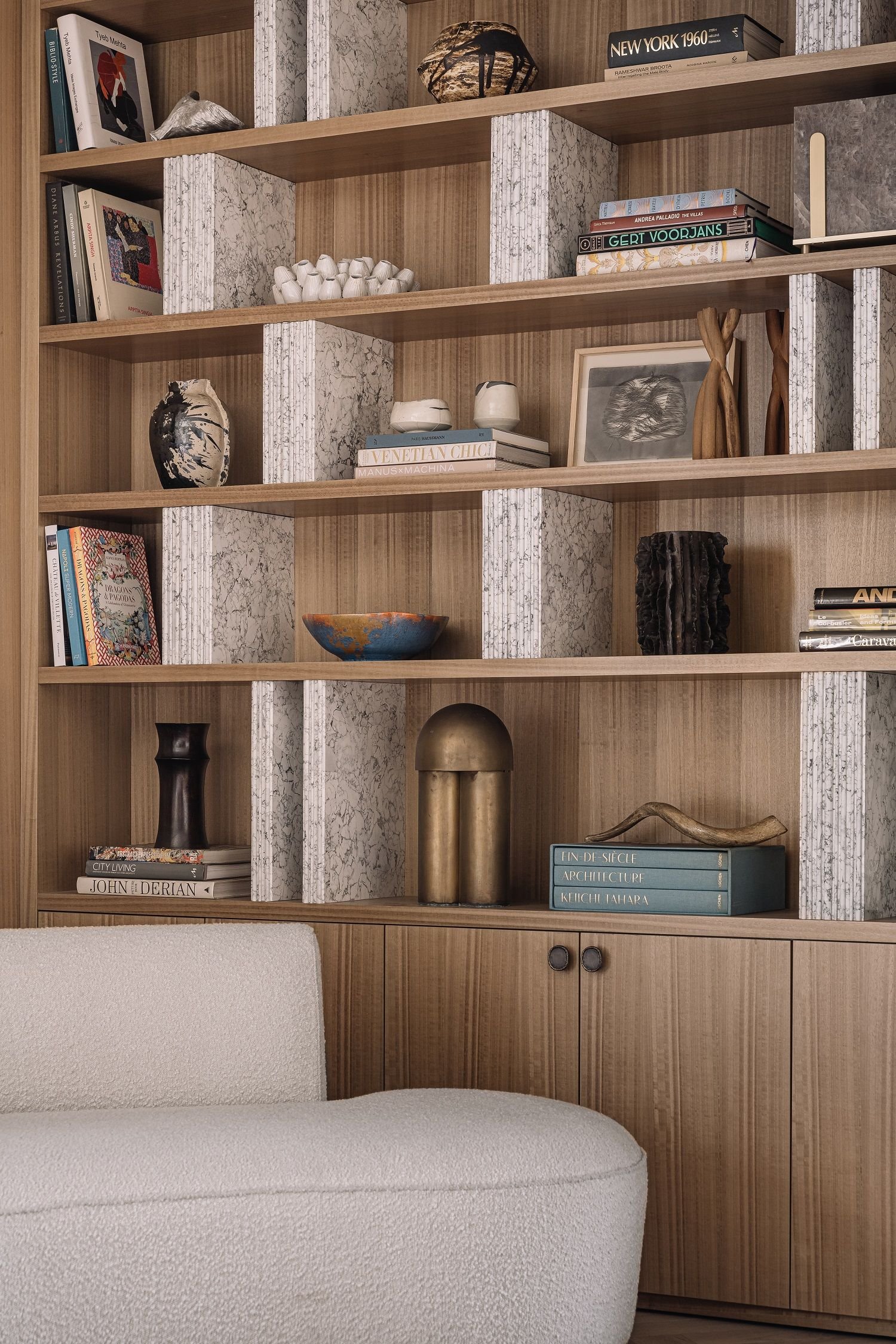
Group objects in sets of three, with each element at a different height. A book stack, a plant, a ceramic vessel.
The triangle implicit in three heights of varying scale is the most stable compositional unit available to shelf styling. It works because it mirrors the visual logic the eye already applies to the natural world. Use it consistently.
25. Bidirectional book stacking as rhythmic counterpoint
Alternating vertical and horizontal book arrangements across shelves introduces rhythmic variation that prevents the uniformity of a standard library arrangement.
Horizontal stacks serve an additional compositional function: they create raised platforms for smaller objects, adding a dimensional layering that distinguishes a styled shelf from an organized one.
Scale as the Determining Variable
Every design decision described above is rendered ineffective by miscalculated scale. This is the single most common error in bookcase selection, and it is entirely avoidable.
A bookcase undersized for the wall reads as tentative. A bookcase oversized for the room reads as oppressive. Neither communicates confidence.
The optimal proportion: the bookcase occupies approximately two-thirds of the available wall width. Where a smaller footprint is intentional, balance the asymmetry with art, lighting, or a second object of comparable visual mass.
Proportion correct, and the design holds. Proportion wrong, and no other decision can compensate.
The Final Step
Twenty-five specific bookcase formats, each suited to a defined context and design objective.
The task now is singular: identify the one that fits your space and your intention, then act on it with commitment. Measure accurately. Select deliberately. Style with an understanding of proportion and visual balance.
The rooms that read as thoughtfully designed rarely got there through comprehensive renovation. More often, they arrived via a single, well-executed decision — a piece of furniture chosen with clarity of purpose.
A bookcase chosen well is, consistently, that decision.
Make it yours.