
Disclosure : This post may contain affiliate links or paid partnerships. I may earn compensation if you click a link or make a purchase, at no additional cost to you. See my disclosure for more info.
You know that feeling when you walk into someone’s kitchen and something just… clicks?
The air feels different. Warmer. The surfaces seem to glow instead of just existing. Every detail looks intentional without looking forced.
You stand there, coffee in hand, and think: why doesn’t my kitchen feel like this?
Then you go home. Open your phone. Pin another beige kitchen. And the cycle repeats.
Pin. Dream. Sigh. Close app. Stare at your actual kitchen. Feel that familiar knot of frustration and longing twist a little tighter.
You’ve been doing this for months.
Here’s what nobody’s told you yet.
That feeling you get in those beautiful kitchens? It’s not about how much money someone spent. It’s about a series of small, intentional decisions — layered together — that create warmth, sophistication, and timelessness.
Beige is the canvas. But the tricks are the brushstrokes.
And you’re about to learn all 29 of them, starting with the details most people treat as afterthoughts but that actually carry disproportionate power.
Start With the Smallest Moves: Hardware and Fixtures That Punch Above Their Weight
Most people obsess over cabinets and paint while treating hardware like an afterthought. That’s a mistake. These tiny metal details set the tone for the entire room.
1. Lean toward unlacquered brass or champagne gold.
Chrome is too stark against warm beige tones. Matte black can feel heavy in a soft palette.
Unlacquered brass brings warmth and ages beautifully — the patina it develops over months and years adds character you can’t buy out of a box. Champagne gold offers similar warmth with a more consistent, polished look.
Both pair with beige like they were made for it.
2. Unify your faucet finish with your cabinet hardware.
Confident metal mixing is a real skill. If you haven’t developed it yet, don’t experiment on your kitchen.
Keep the same finish across handles, knobs, and faucet. That consistency creates a sense of calm, and calm always reads as expensive.
3. Blend your outlet covers into the wall.
Standard white plastic covers on warm beige walls are like pebbles in your shoe — individually small, collectively maddening.
Swap them for covers that match the wall color. Sixty seconds per outlet. Near-zero cost. The visual noise disappears instantly.
The Depth Builder: Texture Strategies That Give Beige Its Dimension
Now for the layer that separates forgettable beige kitchens from ones that make people stop and stare.
Without texture variation, beige is just a color. With it, beige becomes a feeling.
4. Cover your backsplash in zellige tile.
Handmade. Uneven. Each tile catches and releases light differently.
In beige or cream tones, zellige creates a surface that shifts and glimmers throughout the day. It has the kind of depth that factory tiles will never achieve.
Touch it once and you’ll understand why designers are obsessed.
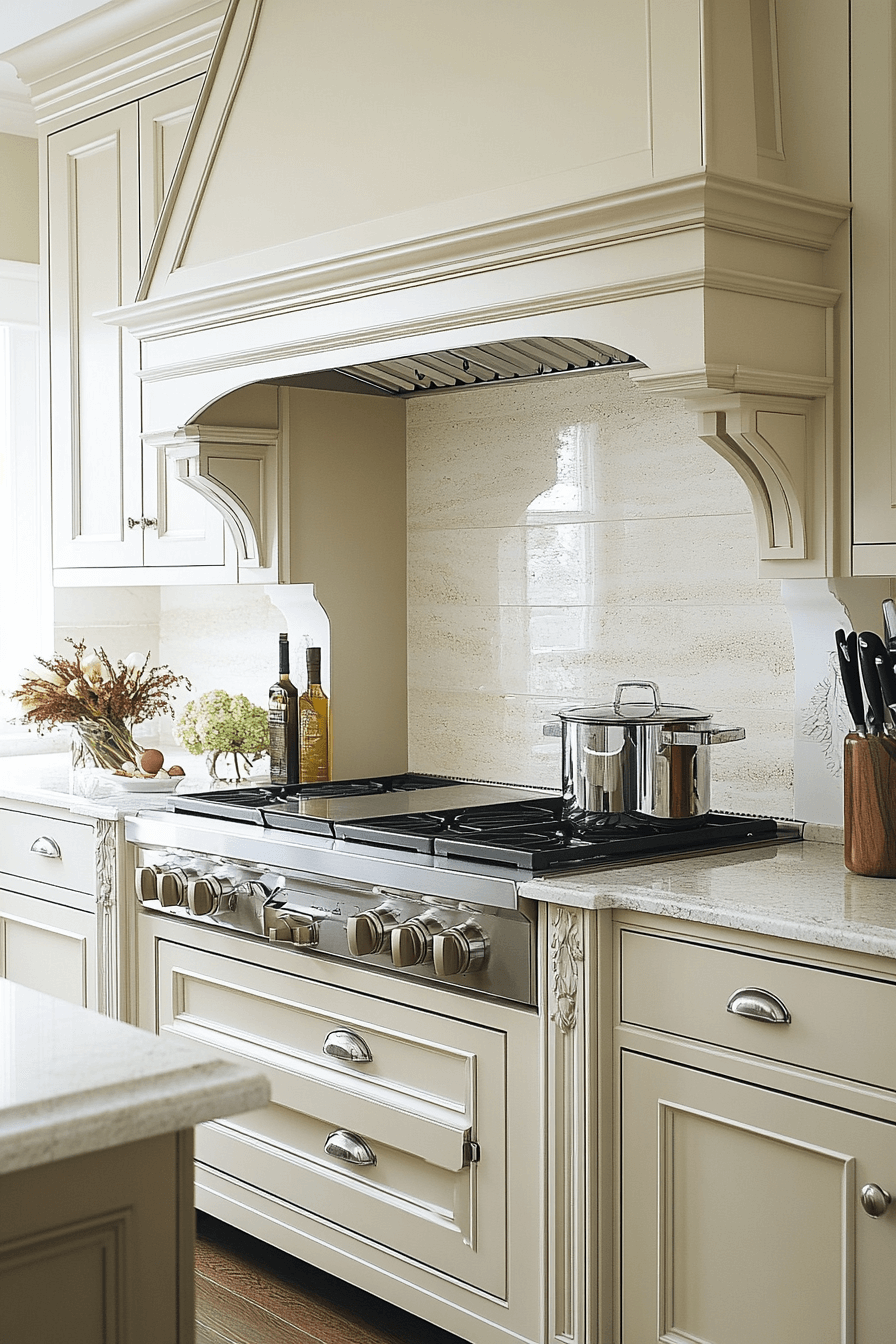
5. Transform your range hood with hand-applied plaster.
Limewash. Roman clay. Venetian plaster. Choose your weapon.
When you coat a standard metal hood in a textured plaster finish, it becomes something entirely different — a sculptural element that responds to changing daylight, revealing new surfaces and shadows hour by hour.
6. Anchor the room with floating wood shelves.
Honey oak. White oak. Light walnut.
Two open shelves in warm-toned natural wood prevent a beige kitchen from flatlining. They bring grain, warmth, and organic depth to an otherwise smooth environment.
Display your most beautiful everyday pieces. Let the shelves look used, not staged.
7. Lay a woven runner along the work zone.
Jute, sisal, or textured wool stretched along the sink or island.
It breaks the monotony of hard flooring, adds cushion underfoot, and quietly declares that this kitchen is as much about comfort as it is about aesthetics.
8. Crown the island with an organic pendant light.
Rattan. Woven cane. Wicker.
One textured hanging fixture introduces shadow play and visual movement that polished finishes can’t create. It’s the texture exclamation point at the end of the room’s design sentence.
Soul Injection: Finishing Details That Make a Space Feel Human
Your kitchen has bones and texture. Now give it a personality.
9. Populate open shelves with handmade ceramics in warm neutrals.
Irregularity is the goal. Pieces that are slightly uneven, slightly varied in shade, clearly touched by human hands.
Three objects at different heights. A stoneware bowl. A clay mug. These are the things that turn a kitchen into a place with a story.
10. Introduce living greenery near the light.
A small olive tree. Herbs on the sill. A cutting of eucalyptus in a vase.
Green and beige is one of the most naturally harmonious pairings in existence. It’s fresh without being loud. Alive without being distracting.
11. Select a composite sink that disappears into the countertop.
White porcelain interrupts the flow. Stainless steel disrupts the warmth.
A sand-toned or biscuit composite sink integrates silently into your beige countertop. The surface reads as continuous. The kitchen feels more unified.
12. Display items in odd-numbered groupings.
Three canisters. Five cookbooks. One board.
Odd numbers create visual balance that even numbers can’t. This is a fundamental design principle that costs you absolutely nothing to implement.
13. Reverse-engineer your most-loved pins.
Open your saved boards and study the kitchens that made your scroll stop.
What do they share? Same tonal range. Same textural balance. Same sense of edited simplicity.
Identifying that pattern is the difference between copying randomly and designing intelligently.
The Invisible Power: How Light Shapes Everything in a Beige Kitchen
Texture and detail are locked in. But none of it reaches its potential without the right light.
14. Switch to warm bulbs throughout — 2700K to 3000K.
Cool-toned bulbs rob beige of everything that makes it beautiful. They leave you with gray, lifeless surfaces.
Warm lighting makes beige radiate. Like honey. Like butter on warm bread. Check every single fixture in the room and replace any bulb above 3000K.
15. Layer in under-cabinet LED lighting.
Soft strips beneath upper cabinets wash the work surface in a warm, diffused glow. Shadows vanish. Materials come alive. Your backsplash texture becomes visible in a whole new way.
When the overheads go off at night, this ambient layer transforms the kitchen entirely.
16. Add a dimmer to your main light source.
Beige changes dramatically with light intensity. A dimmer gives you control over that shift — from bright and functional to low and atmospheric — at the twist of a dial.
This isn’t a luxury upgrade. In a beige kitchen, it’s foundational.
The Beige Starting Point: Getting the Base Right Before Anything Else
Every trick above relies on a solid foundation. Mess up the base and everything built on top wobbles.
17. Identify your undertone before you choose any shade.
Beige hides its true nature in undertones — pink, yellow, green, gray. Two beiges that look identical on a shelf can create totally different feelings on a wall.
White paper reveals the truth. Hold the sample against it. The undertone emerges. Choose the undertone first. Everything follows from there.
18. Calibrate your beige warmth to your kitchen’s light direction.
North-facing equals cool, blue light. Your beige must lean warm to compensate — gold, honey, wheat.
South-facing equals warm, abundant sunlight. A cooler, grayer beige will still feel inviting because the sun adds the warmth for you.
This isn’t opinion. It’s optics. Respect it or wrestle with it forever.
19. Live with your paint sample for 48 full hours.
Watch it at dawn. Watch it at noon. Watch it under your kitchen’s artificial lights at night.
Three lighting conditions. Three different colors. Same paint.
Two days of observation prevents two years of regret.
20. Use matte on walls, satin on cabinetry.
Matte walls absorb light softly and create a velvety, rich surface. Beautiful.
Matte cabinets absorb fingerprints and cooking grease. Not beautiful. Satin finish gives you the sheen, the durability, and the easy cleanup that daily kitchen life demands.
Where Function Gets Beautiful: Countertop and Surface Mastery
With your palette and atmosphere established, turn your attention to the surfaces that anchor the middle of the room.
21. Prioritize soft veining over bold, dramatic patterns.
High-contrast stone competes with a beige palette rather than supporting it. The stone becomes the focal point when everything should feel harmonious.
Choose quartz or marble with delicate wisps of cream, taupe, or warm gray. Let the surface complement, not dominate.
22. Go thick on your countertop edge — two inches or more.
A thin edge undermines the quality of whatever sits on top of it. Full stop.
A substantial edge profile — thick, mitered, or waterfall — gives your countertop visual weight and communicates that this surface was chosen with intention.
23. Send the countertop cascading down the island with a waterfall edge.
Material flowing unbroken from surface to floor creates a sculptural monolith effect. In warm beige or sand, it evokes carved natural stone.
It’s a dramatic gesture that somehow feels completely serene.
24. Tie the backsplash to your countertop, not your cabinets.
Linking backsplash and countertop in the same material or tone creates visual continuity. The eye reads one flowing surface instead of three disconnected zones.
Result: the kitchen feels larger, calmer, and more designed.
The Structural Frame: Cabinet Decisions That Shape the Room
Last but absolutely not least. Cabinets claim the most real estate in your kitchen. They deserve your most careful attention.
25. Build on a shaker-style door foundation.
Flat slab can feel sterile. Raised panel can feel dated.
Shaker splits the difference — modern enough, detailed enough, timeless enough. It’s never been out of style, and it works with every shade of beige imaginable.
26. Take cabinets to the ceiling without exception.
The gap between cabinet top and ceiling is dead space — visually and literally. Fill it.
Ceiling-height cabinetry makes the room feel taller, more intentional, and dramatically more polished. The dust bunnies disappear too.
27. Use two beige tones — softer uppers, richer lowers.
Pale cream or off-white above keeps things open and airy. A warmer, deeper sand below grounds the composition and hides daily scuffs.
Non-negotiable rule: same undertone family for both. Mismatched undertones create a visual tension that no accessory can resolve.
28. Sculpt your island with fluted or reeded panels.
A flat island face is an unused canvas. Vertical fluting adds architectural texture, shadow lines, and the kind of dimensional interest that makes a basic island look custom-built.
Maximum visual impact. Minimal cost increase.
29. Use hardware on lower cabinets only — leave uppers handle-free.
Clean upper cabinet fronts pull the eye upward without resistance. The room expands visually.
Pulls and handles on lowers sit right where your hands naturally go — providing function and texture at arm level. Purposeful. Clean. Effective.
Go Build the Kitchen That Keeps You
Let’s be honest.
You’ve spent enough time dreaming. Enough time pinning. Enough time standing in a kitchen that doesn’t match what you see in your head.
The truth is, a beige kitchen that stops hearts isn’t about luck or money. It’s about knowing which tricks matter and applying them with intention.
Texture. Light. Undertone. Proportion. Restraint.
Twenty-nine moves. That’s the distance between where you are and where you want to be.
So print this out. Bookmark it. Share it with whoever is helping you build this thing. And start moving — one trick at a time — toward the kitchen that makes you want to linger in the doorway just to take it in.
It’s not a fantasy anymore.
It’s a checklist.
And you’re ready.